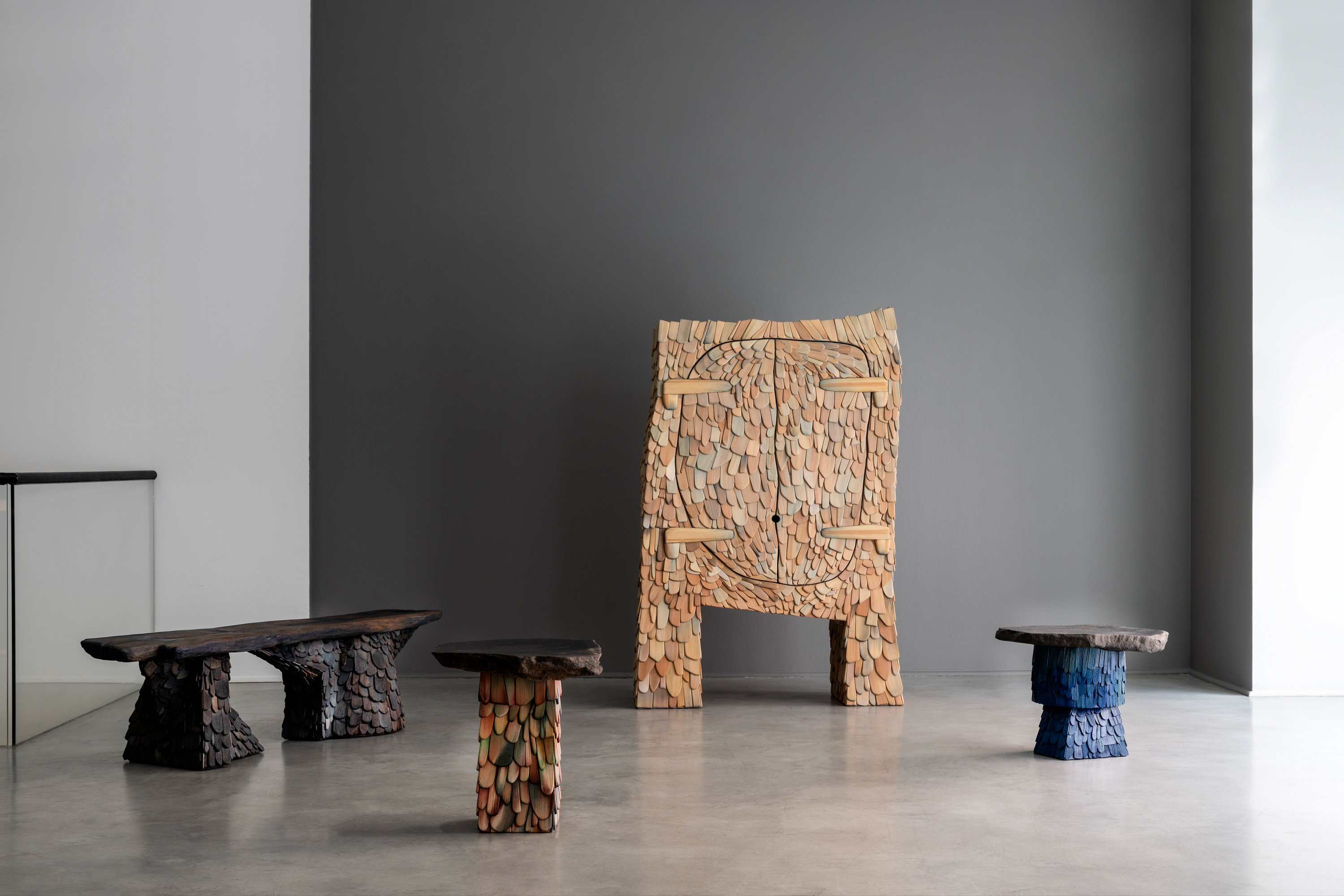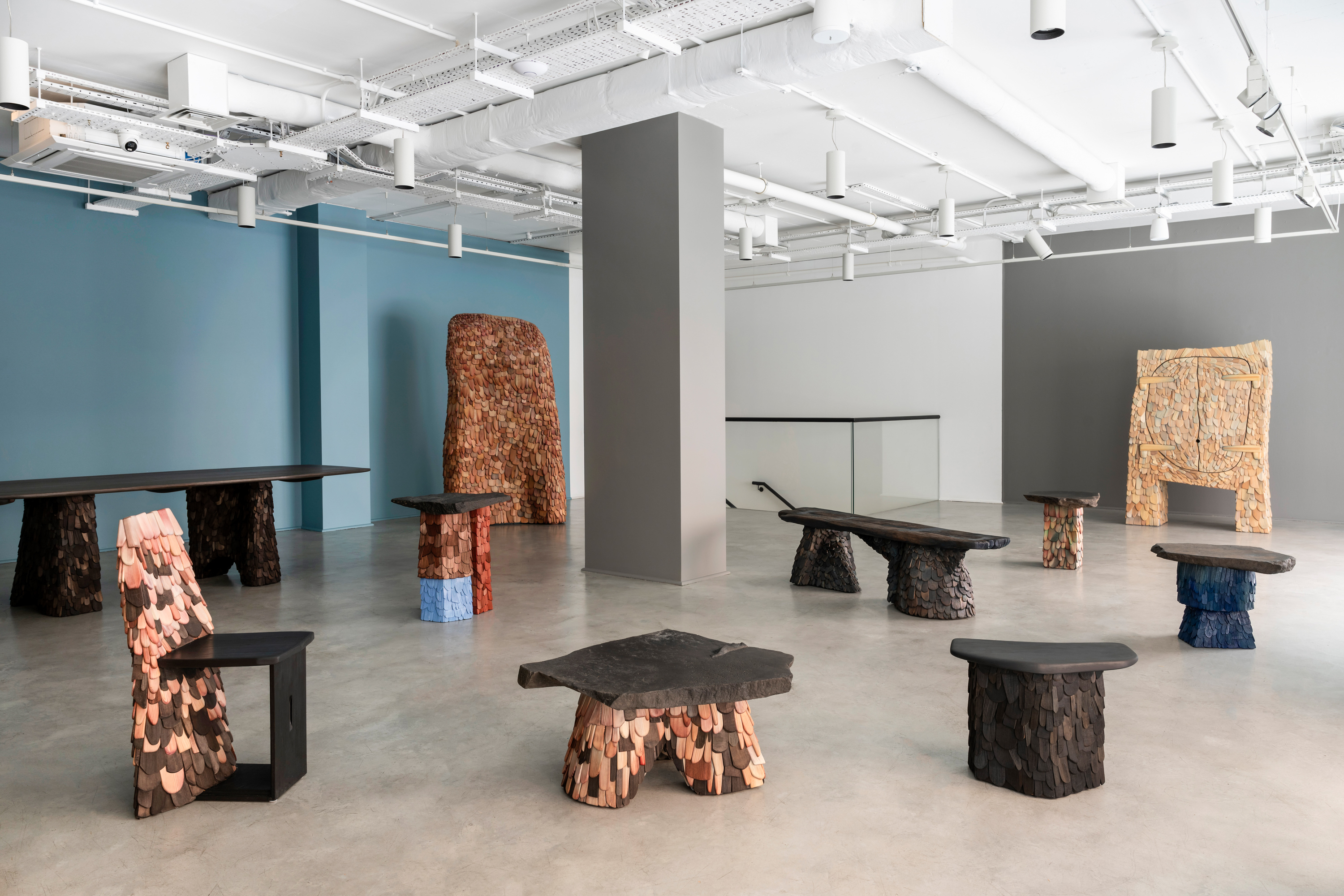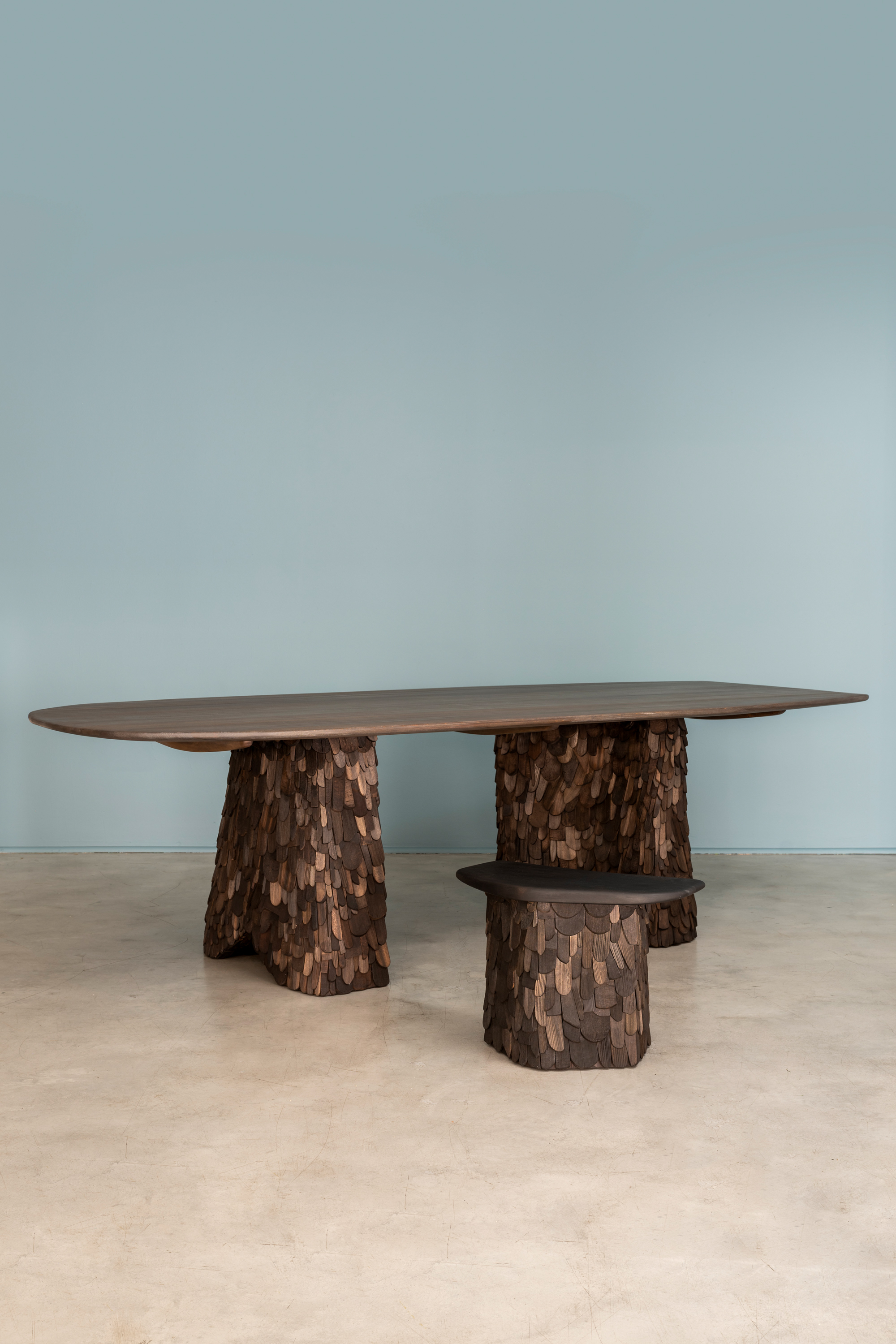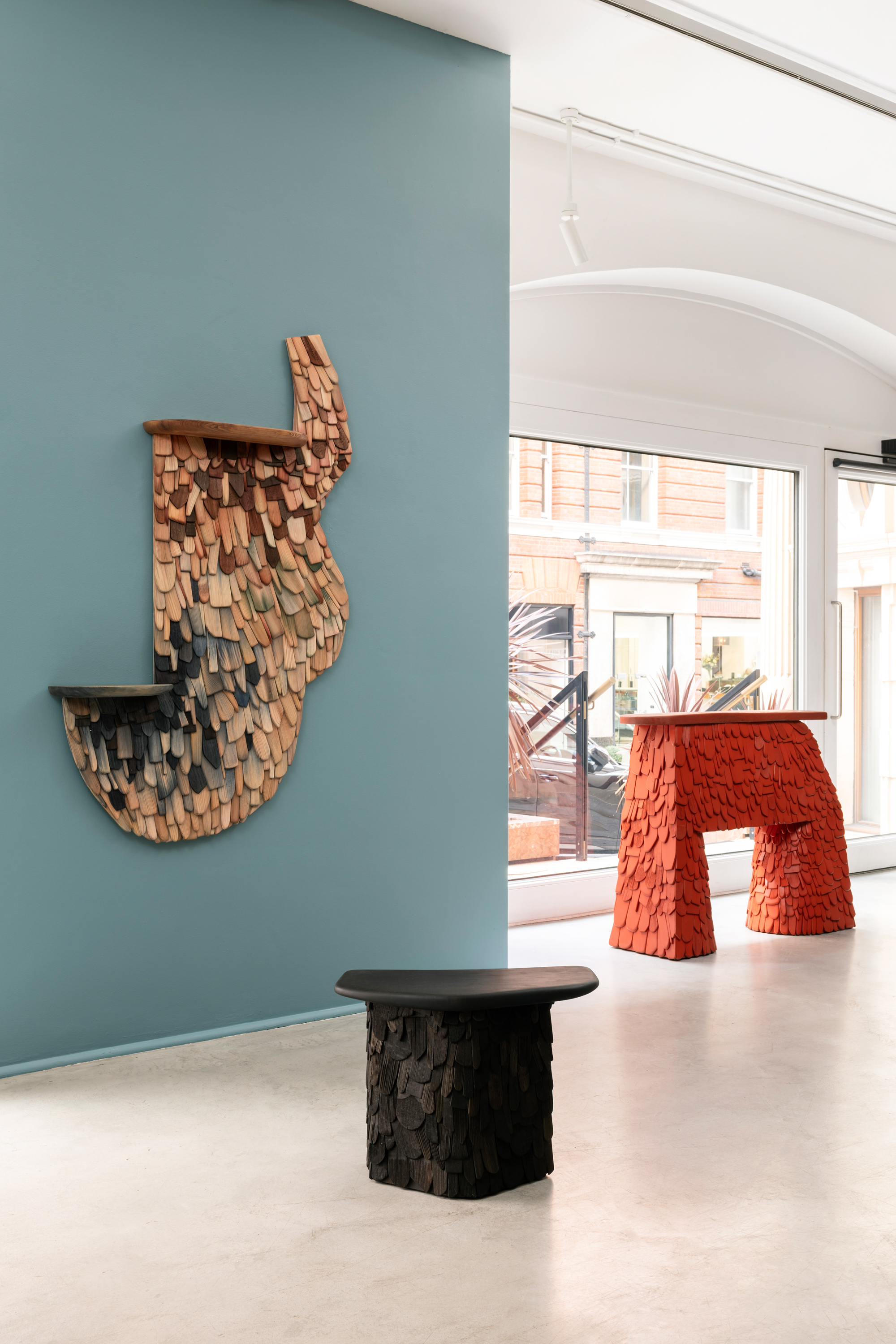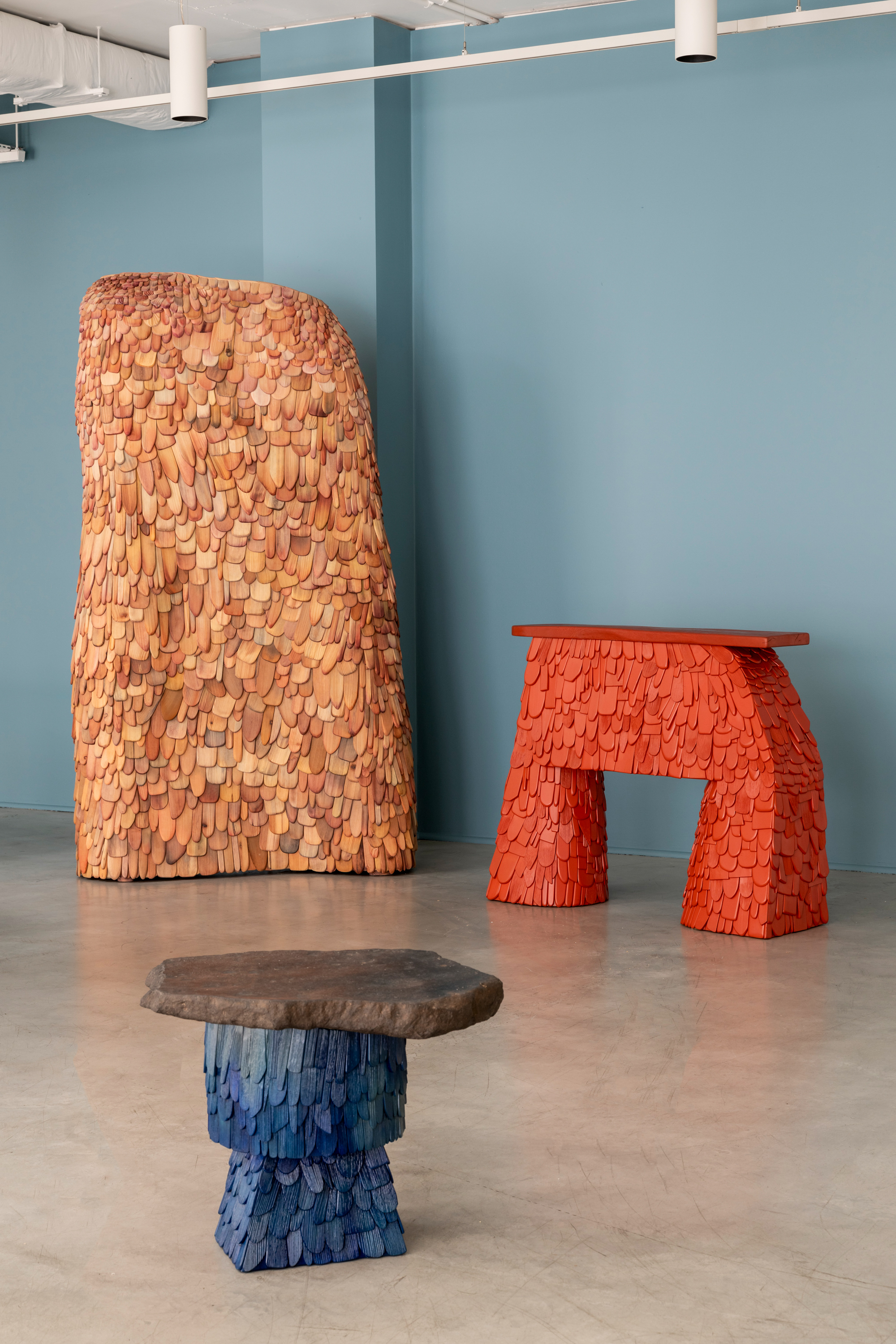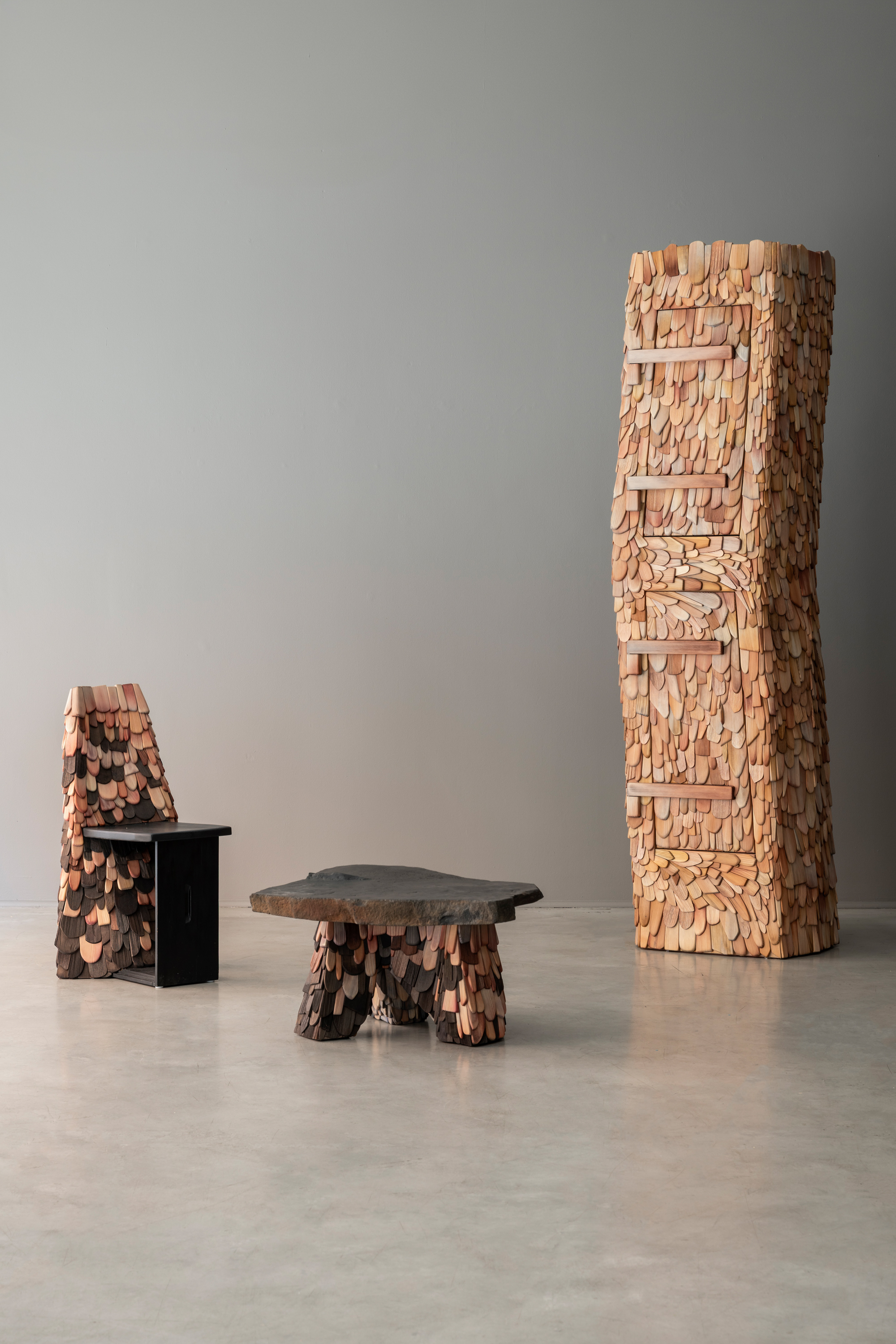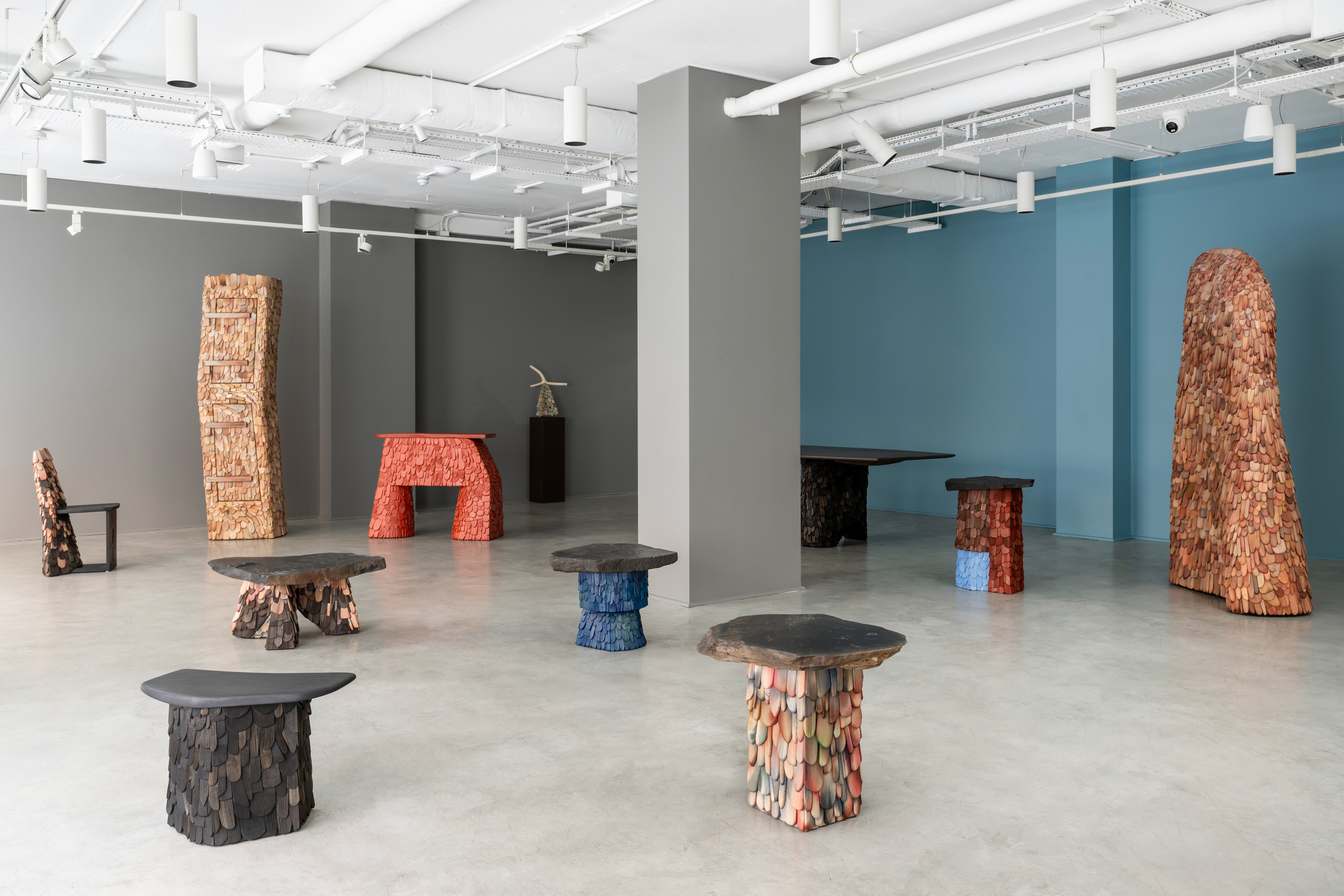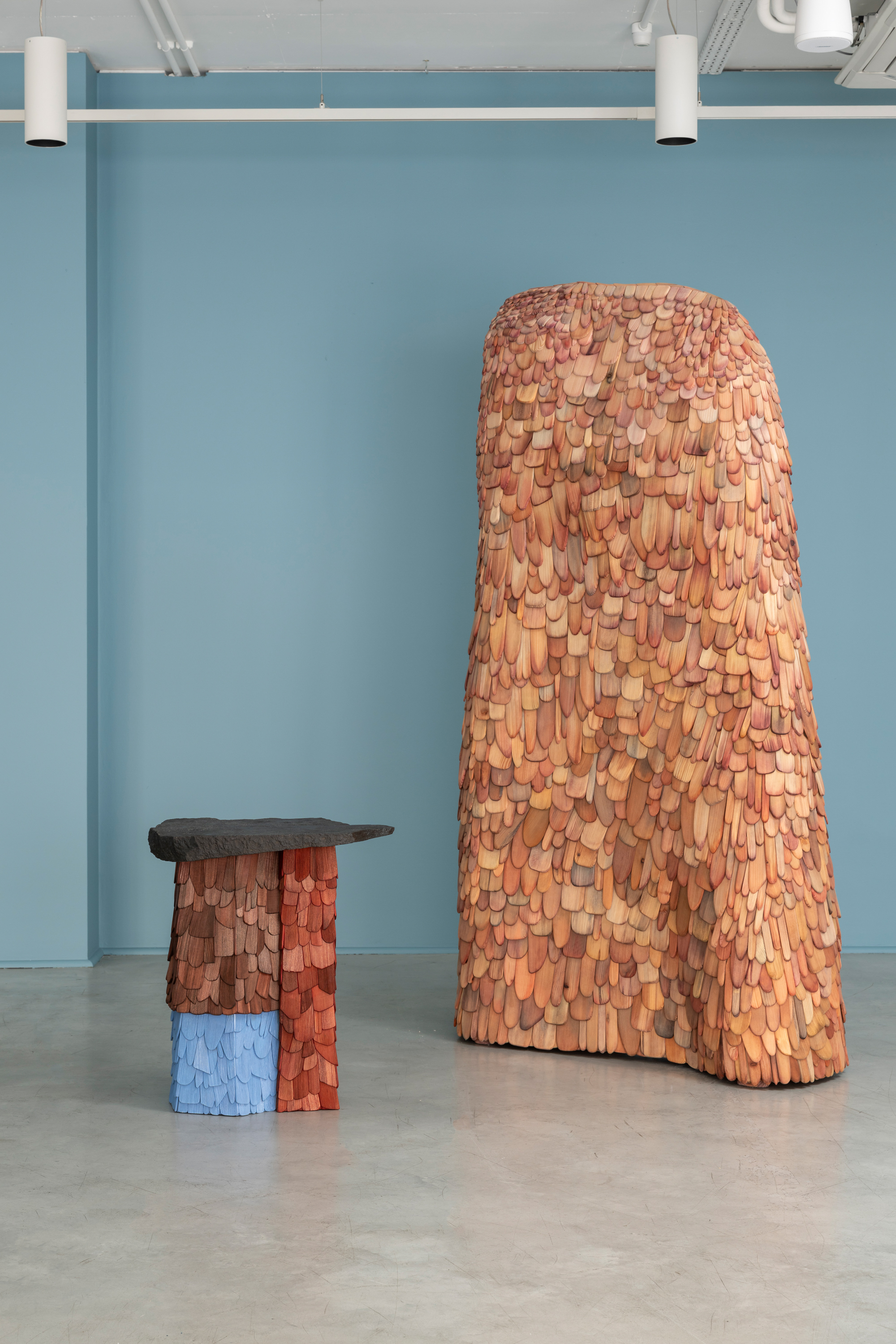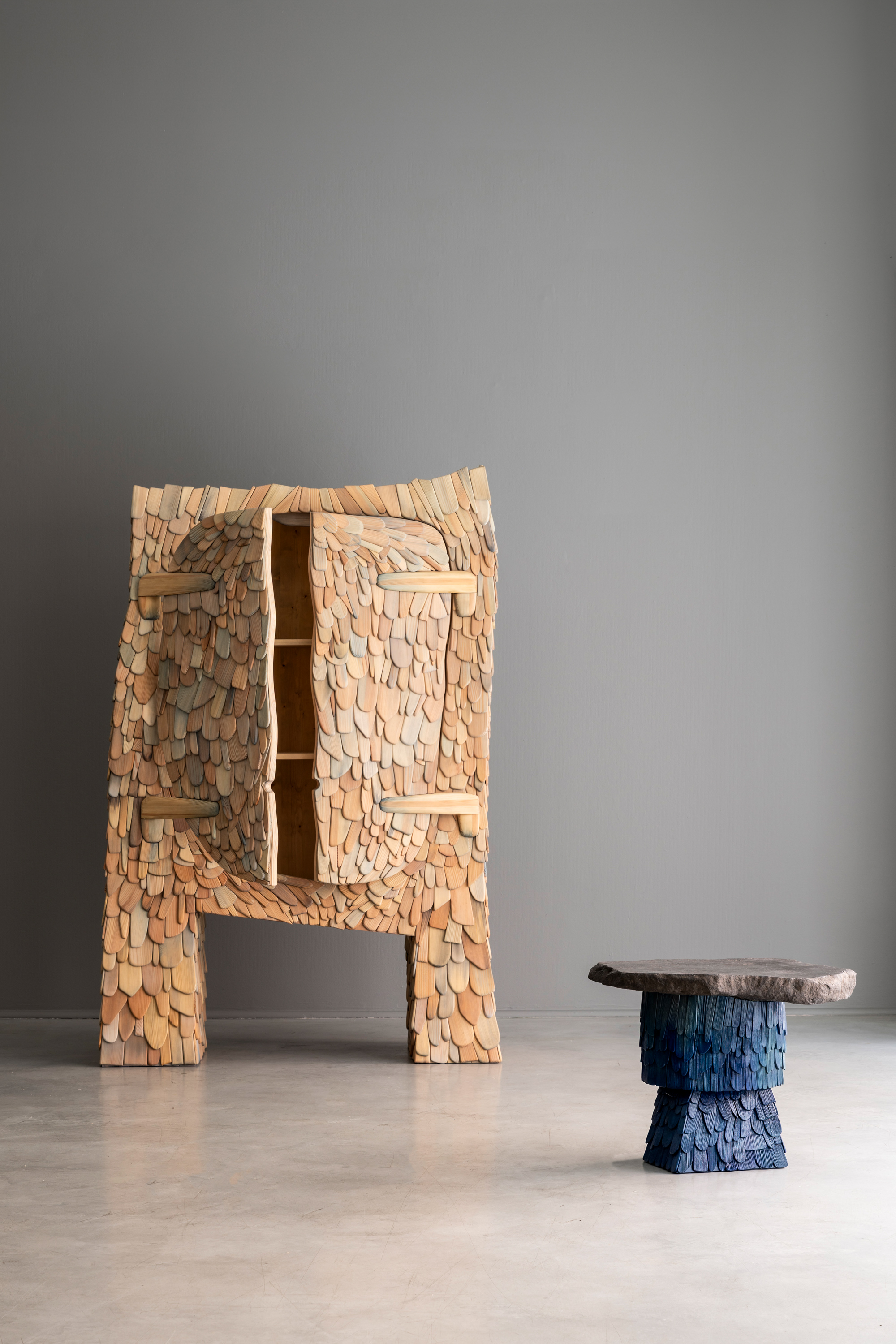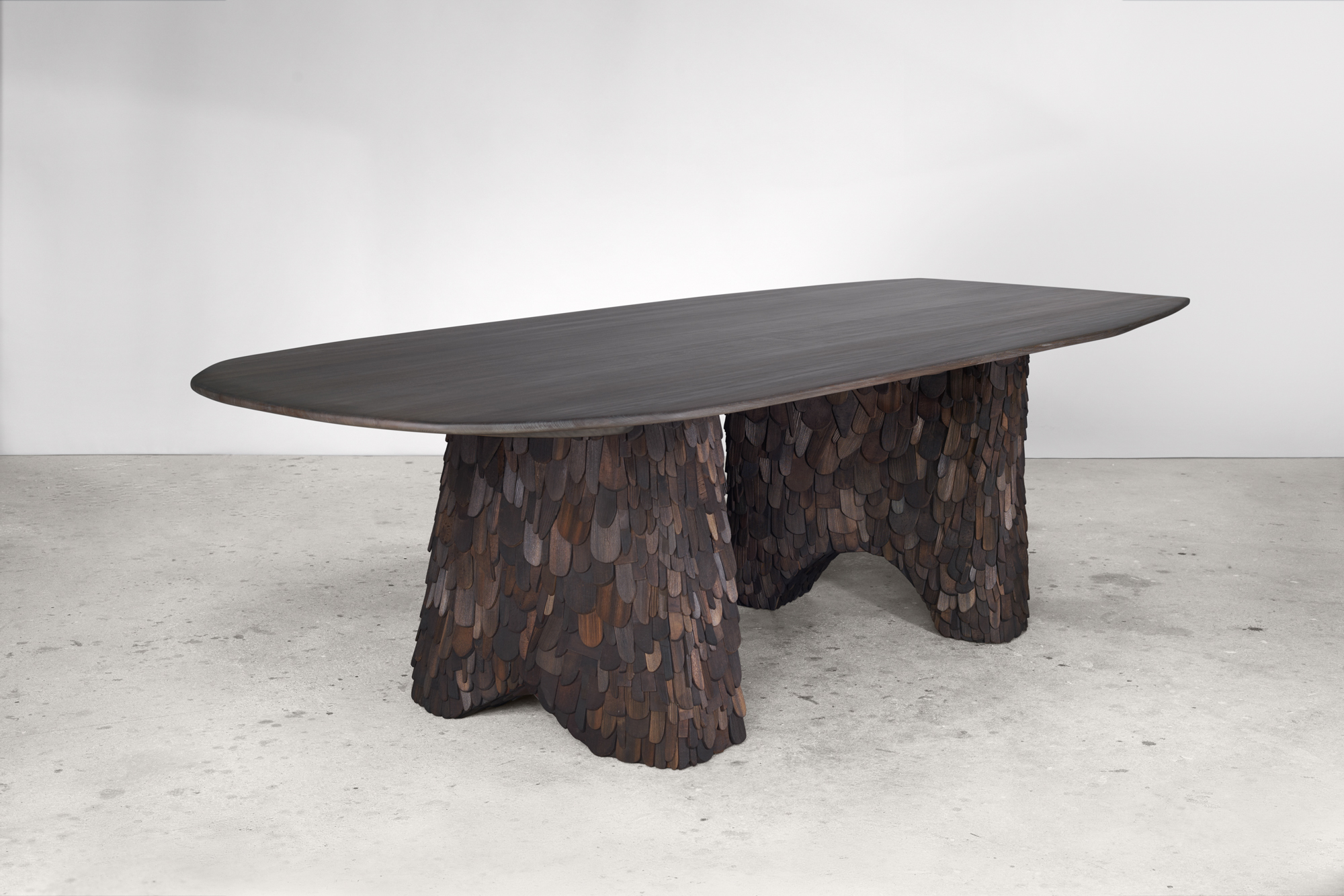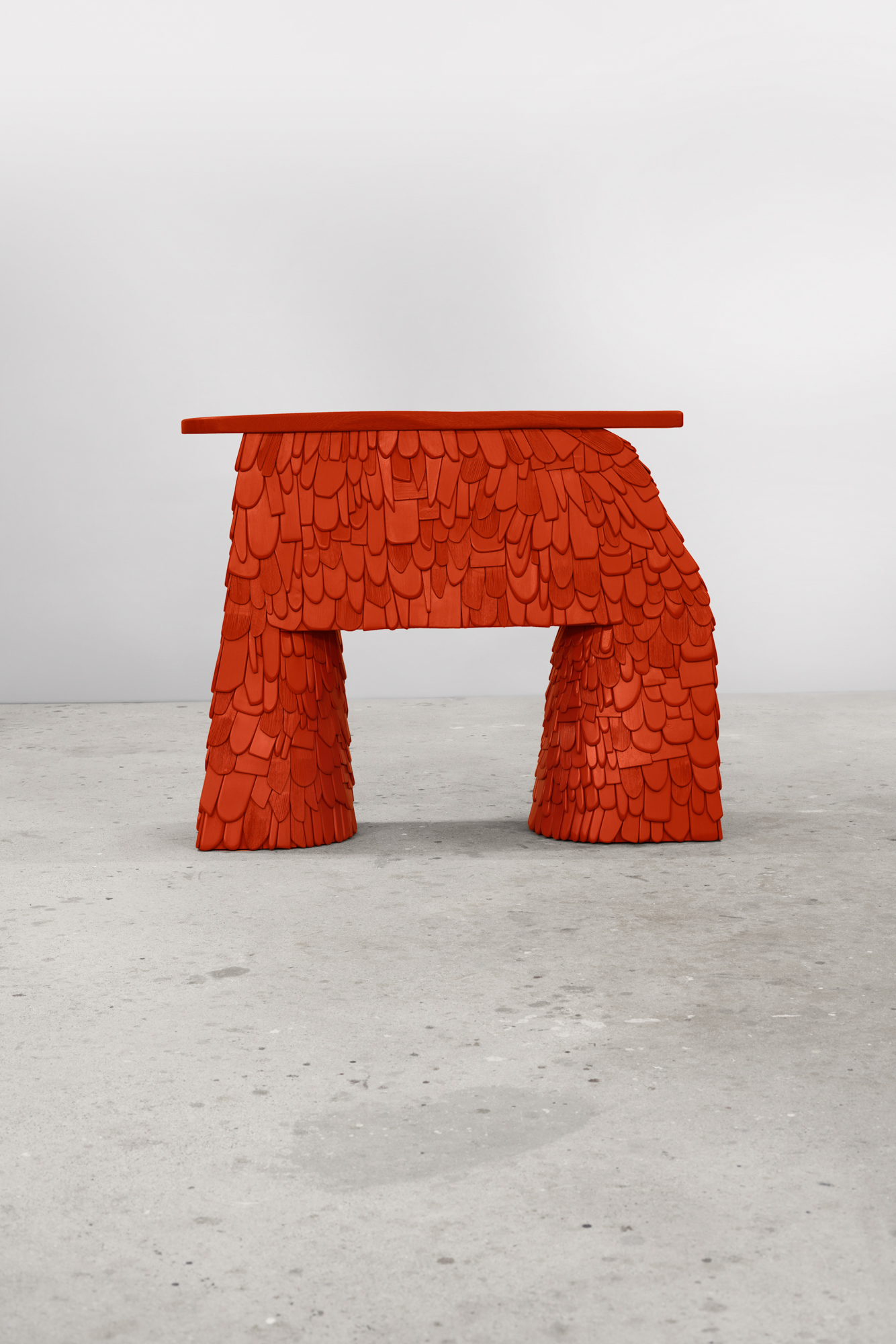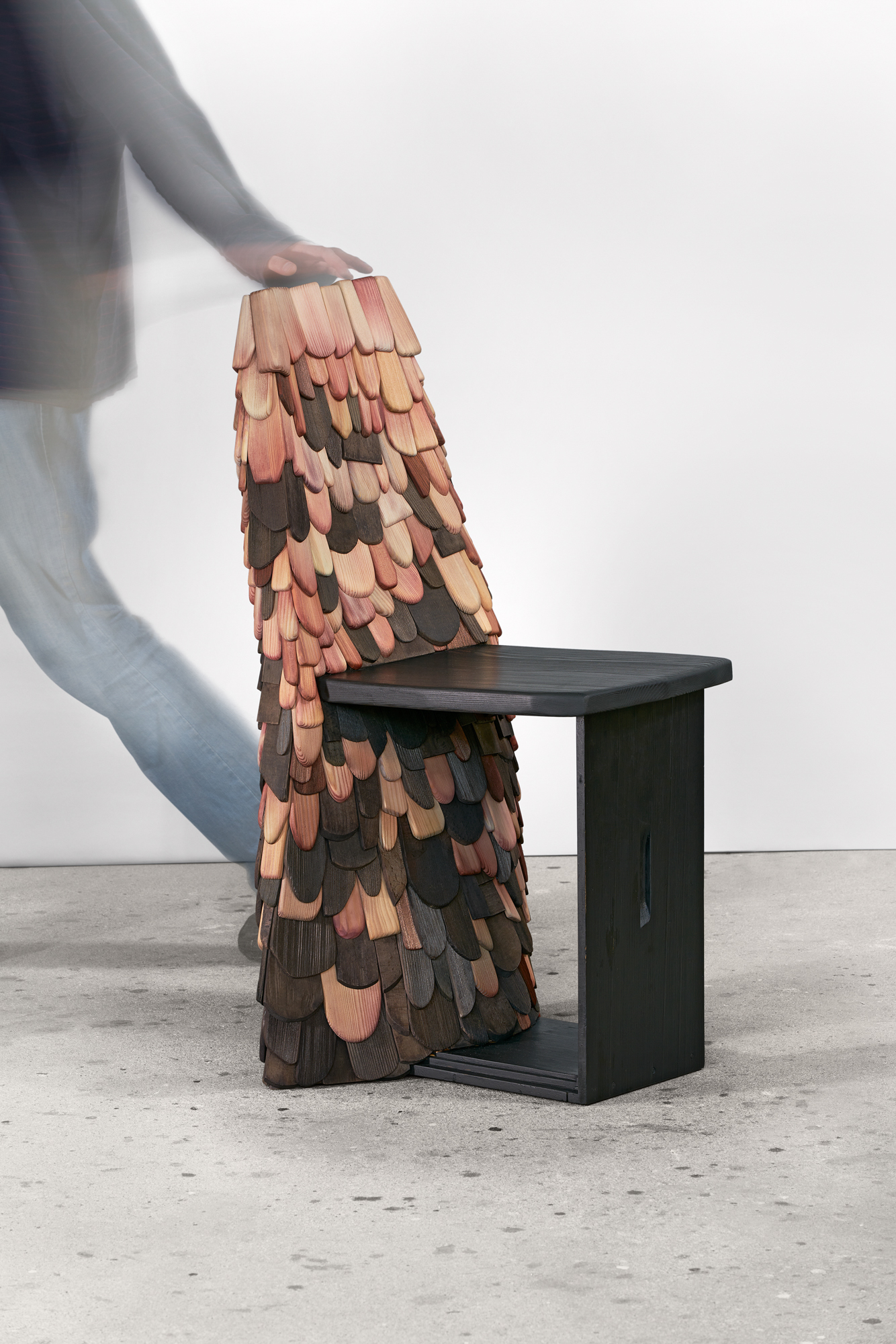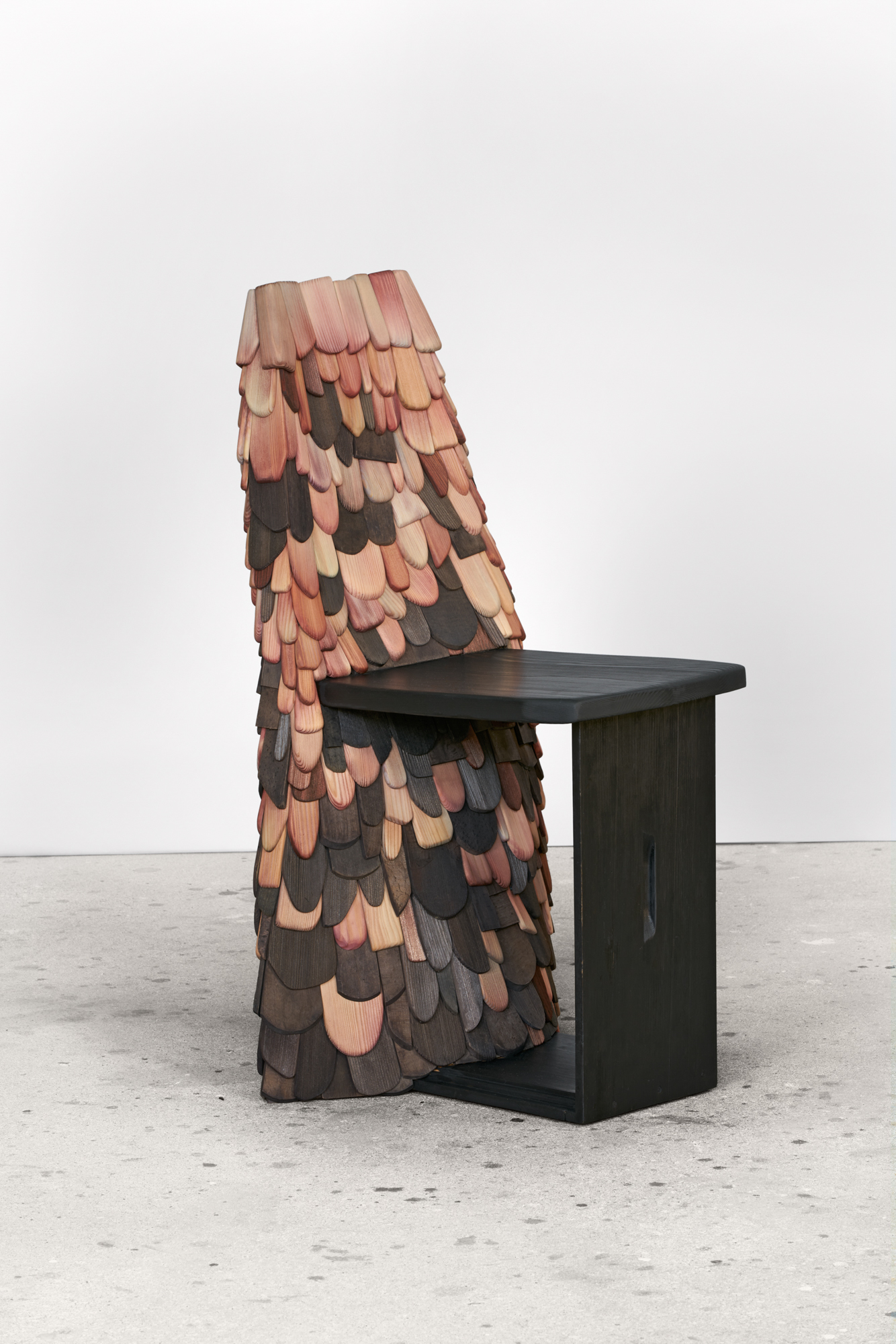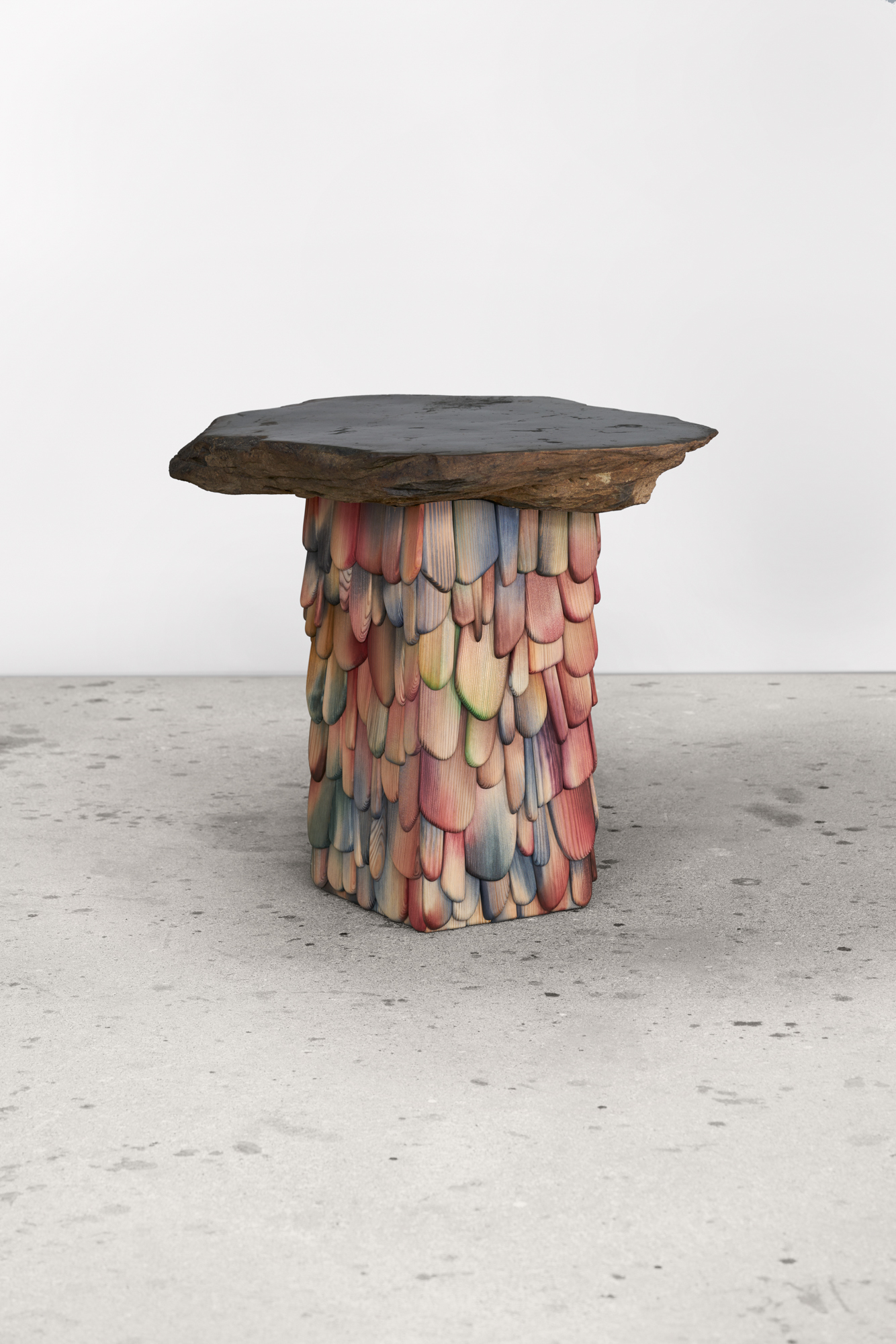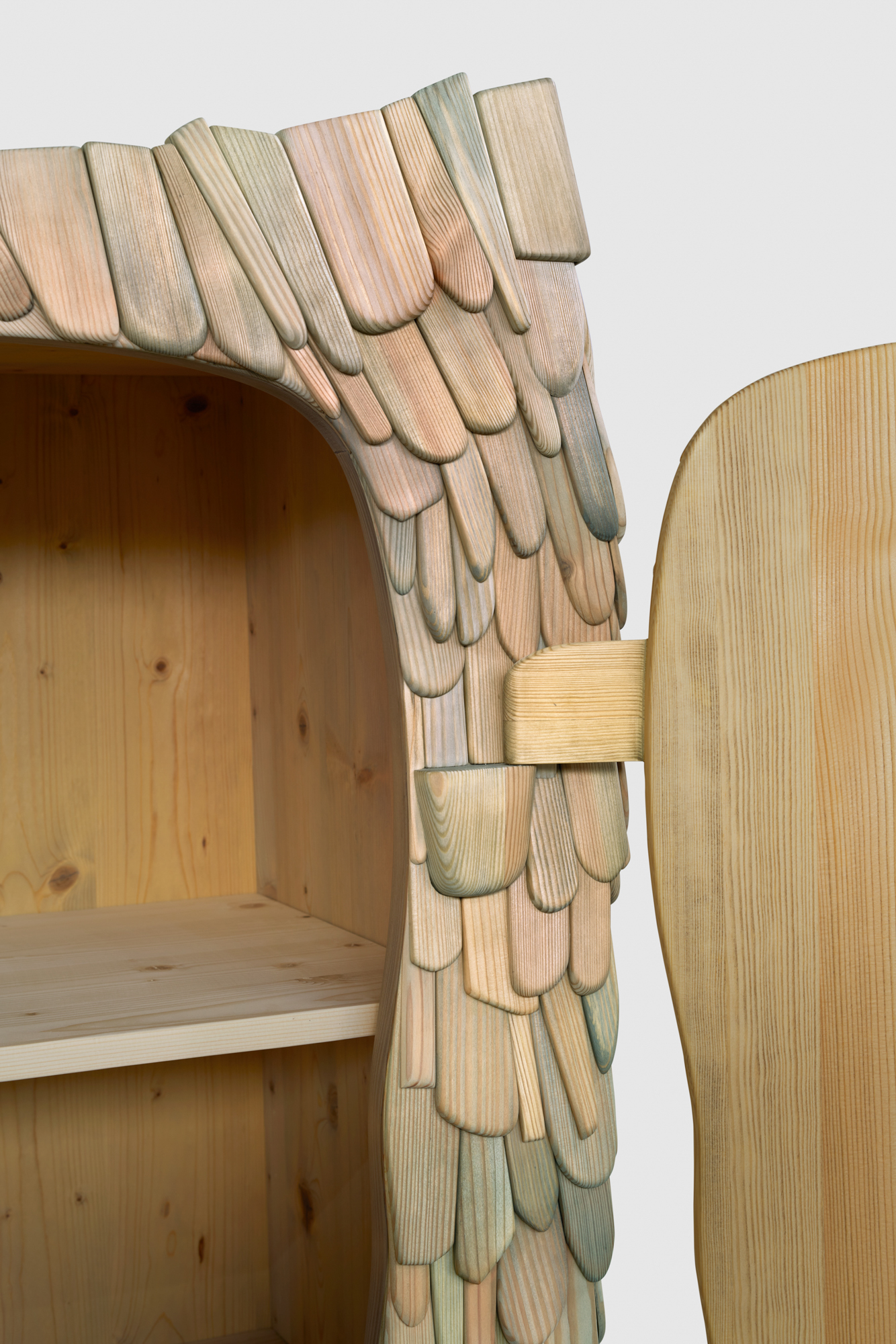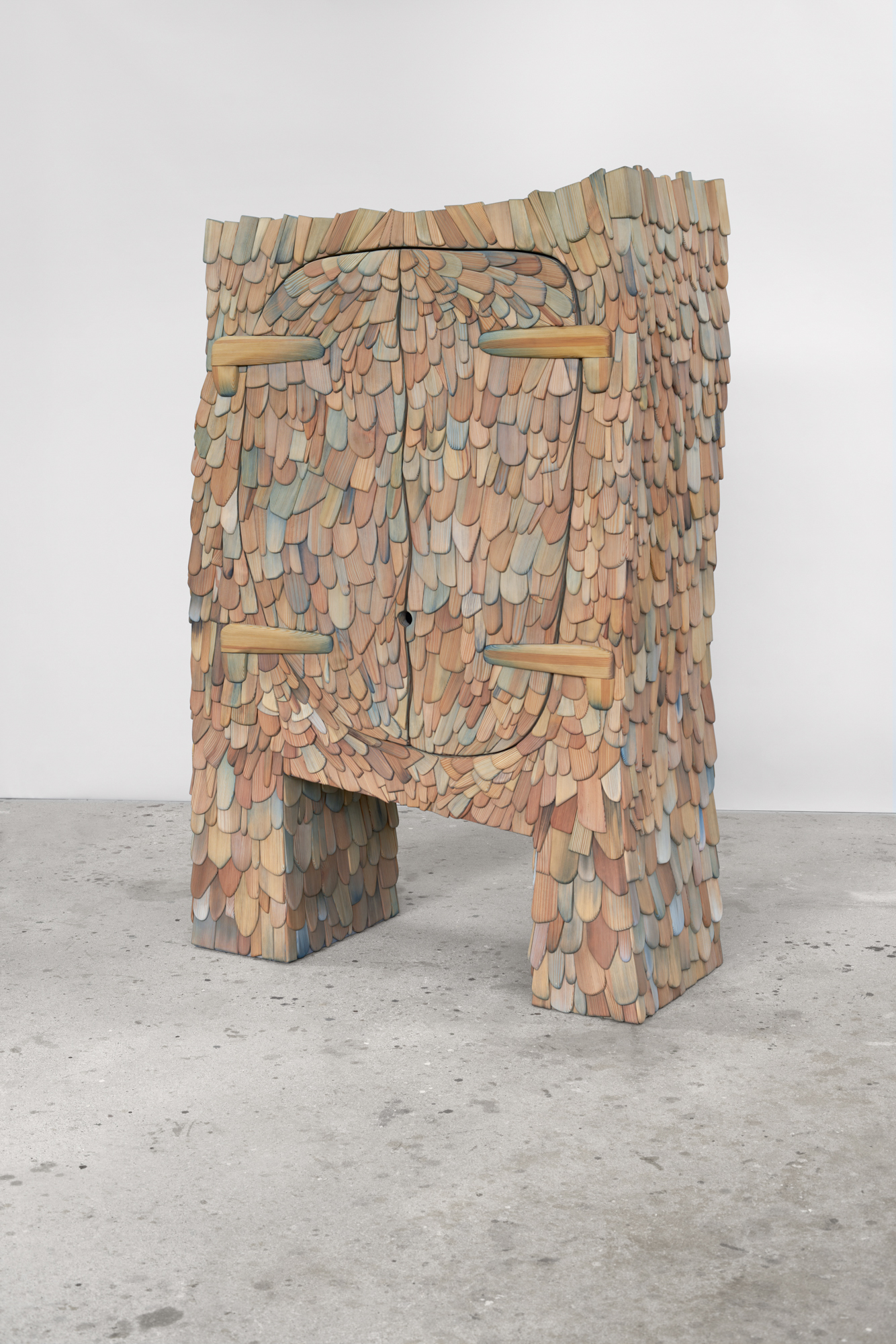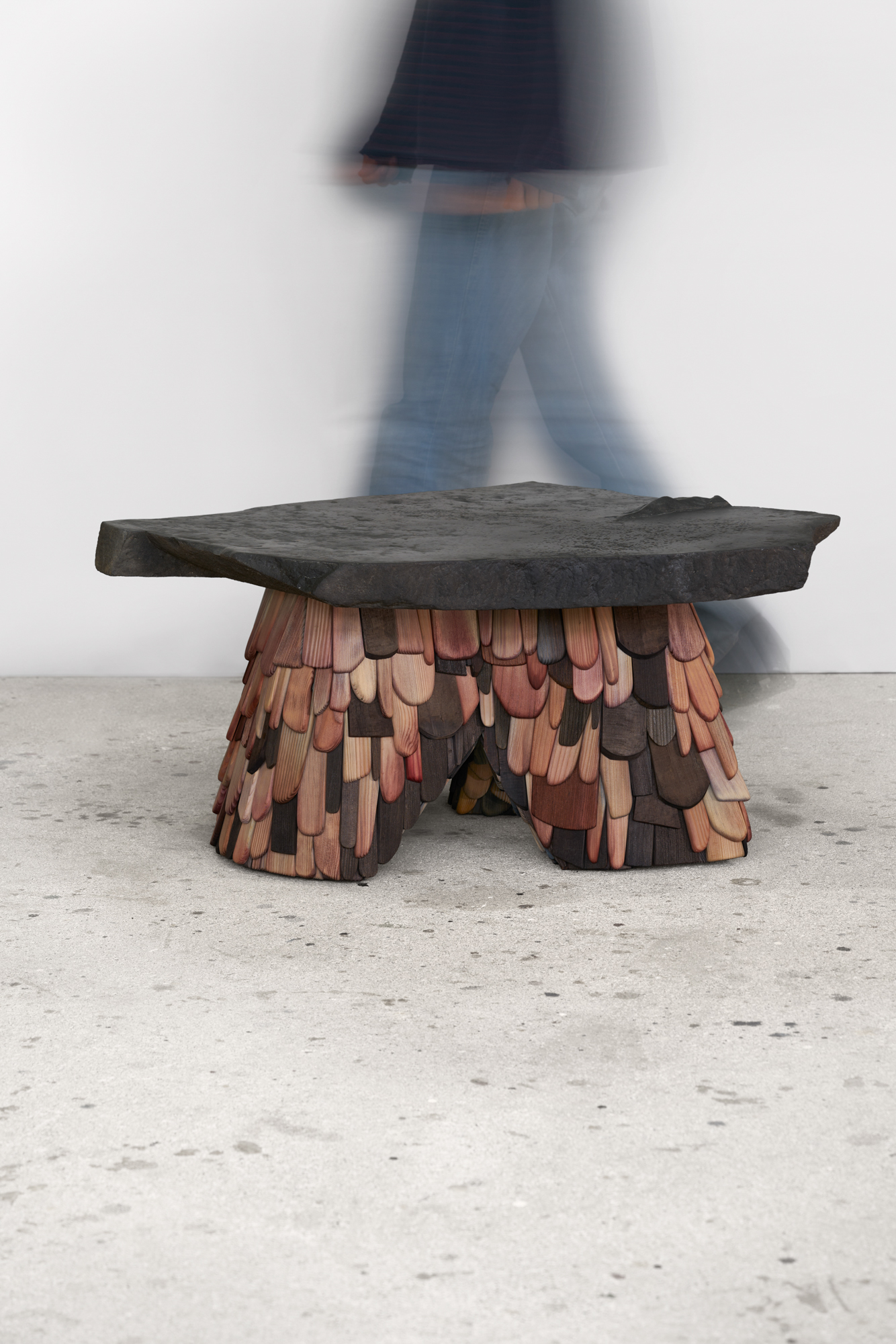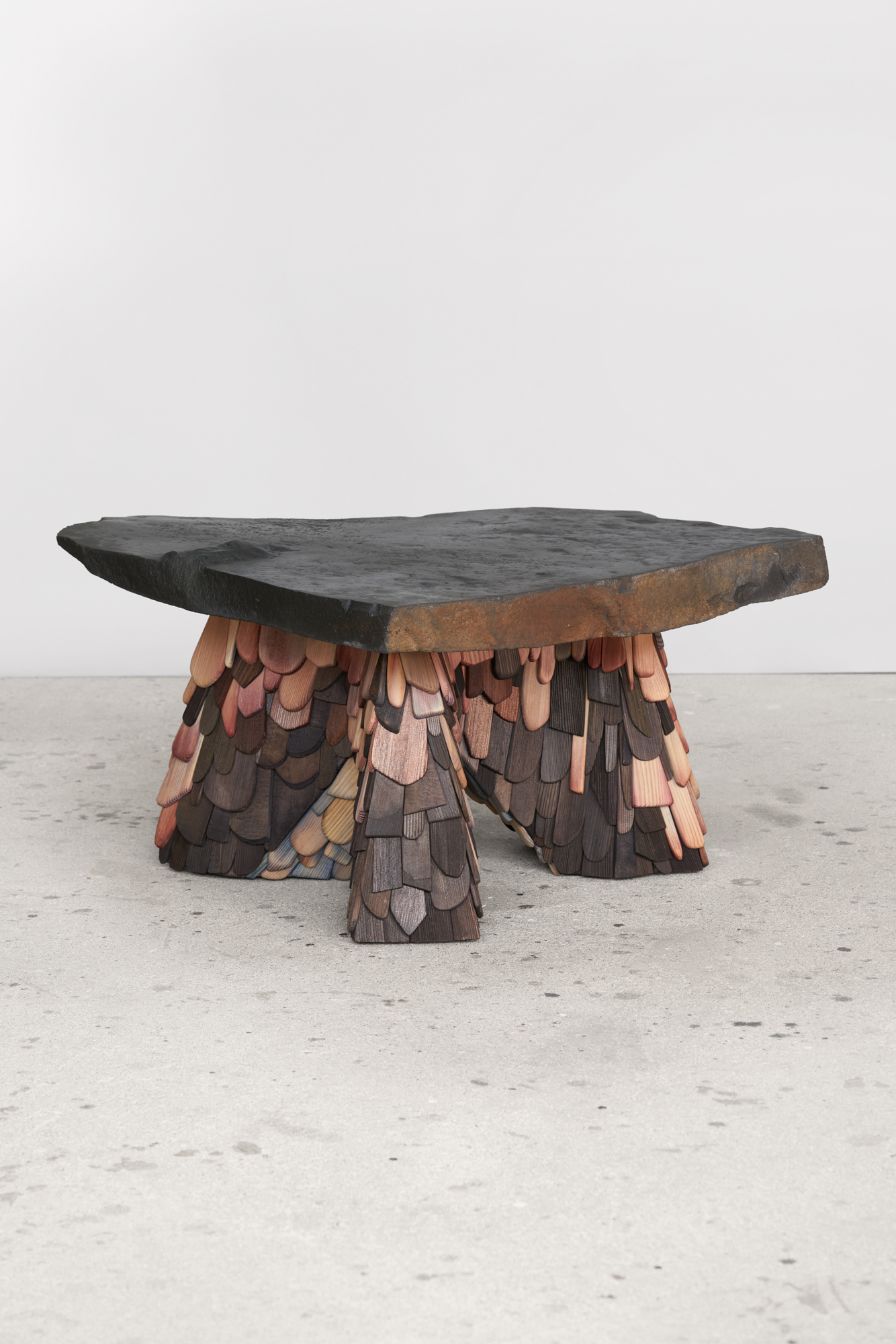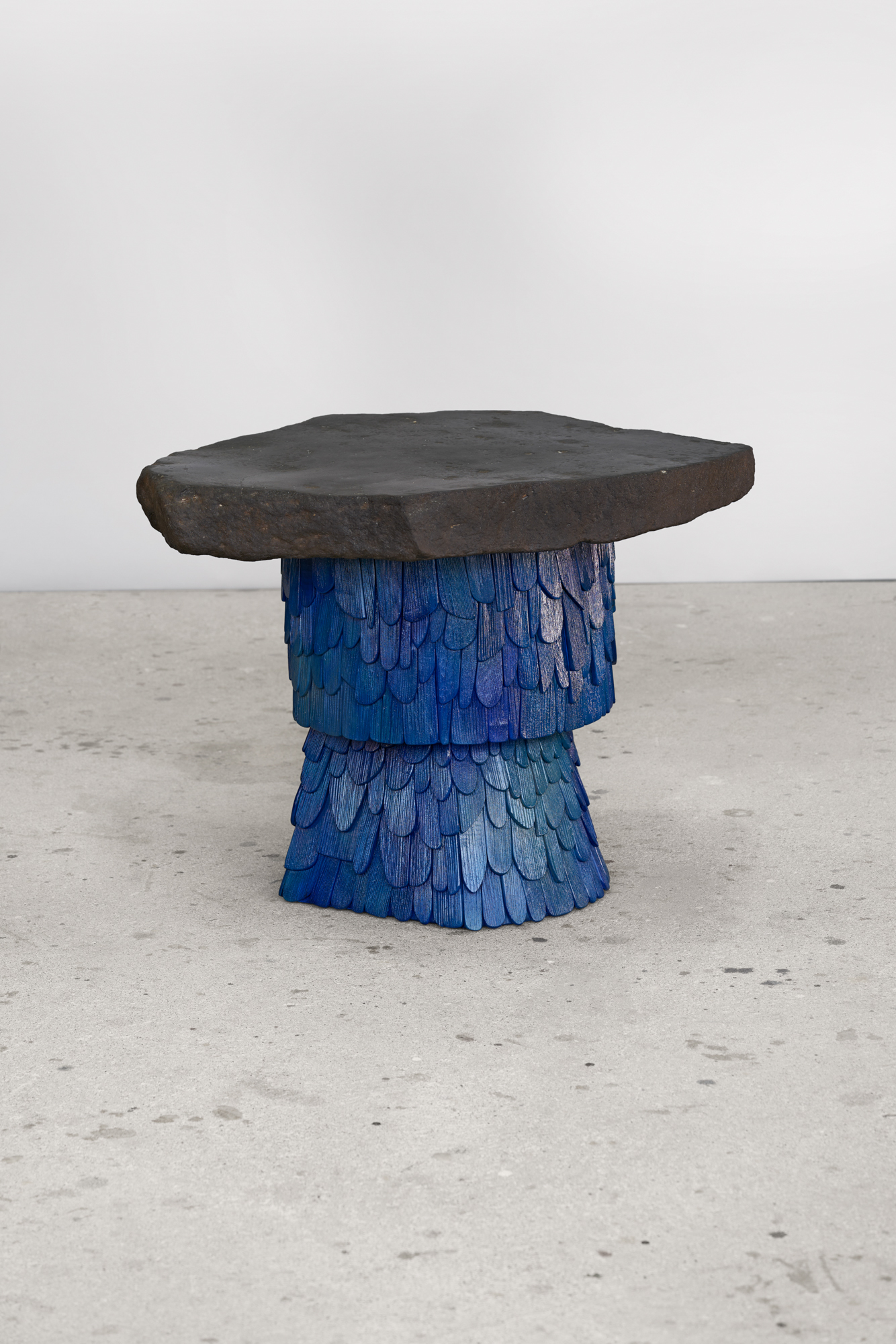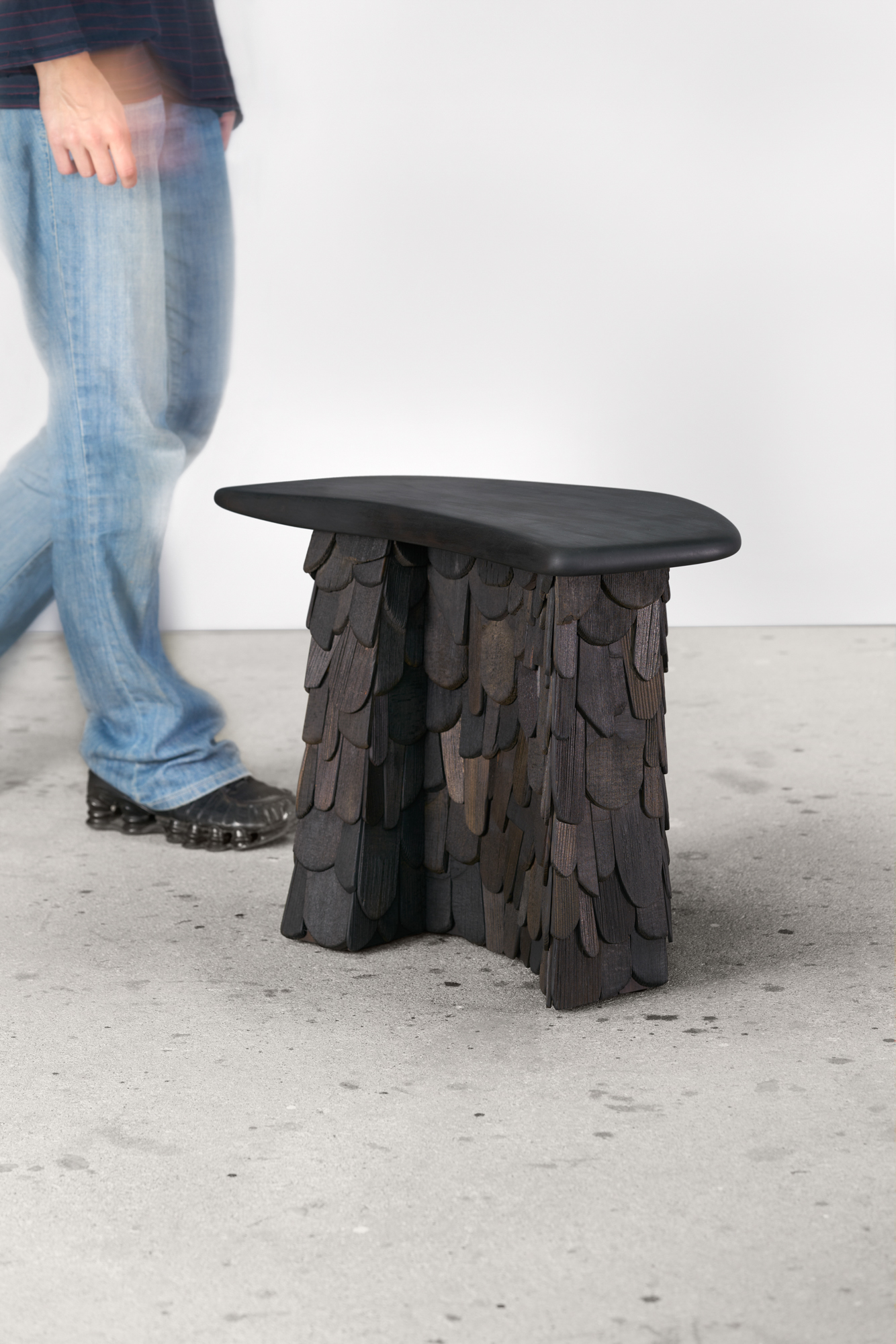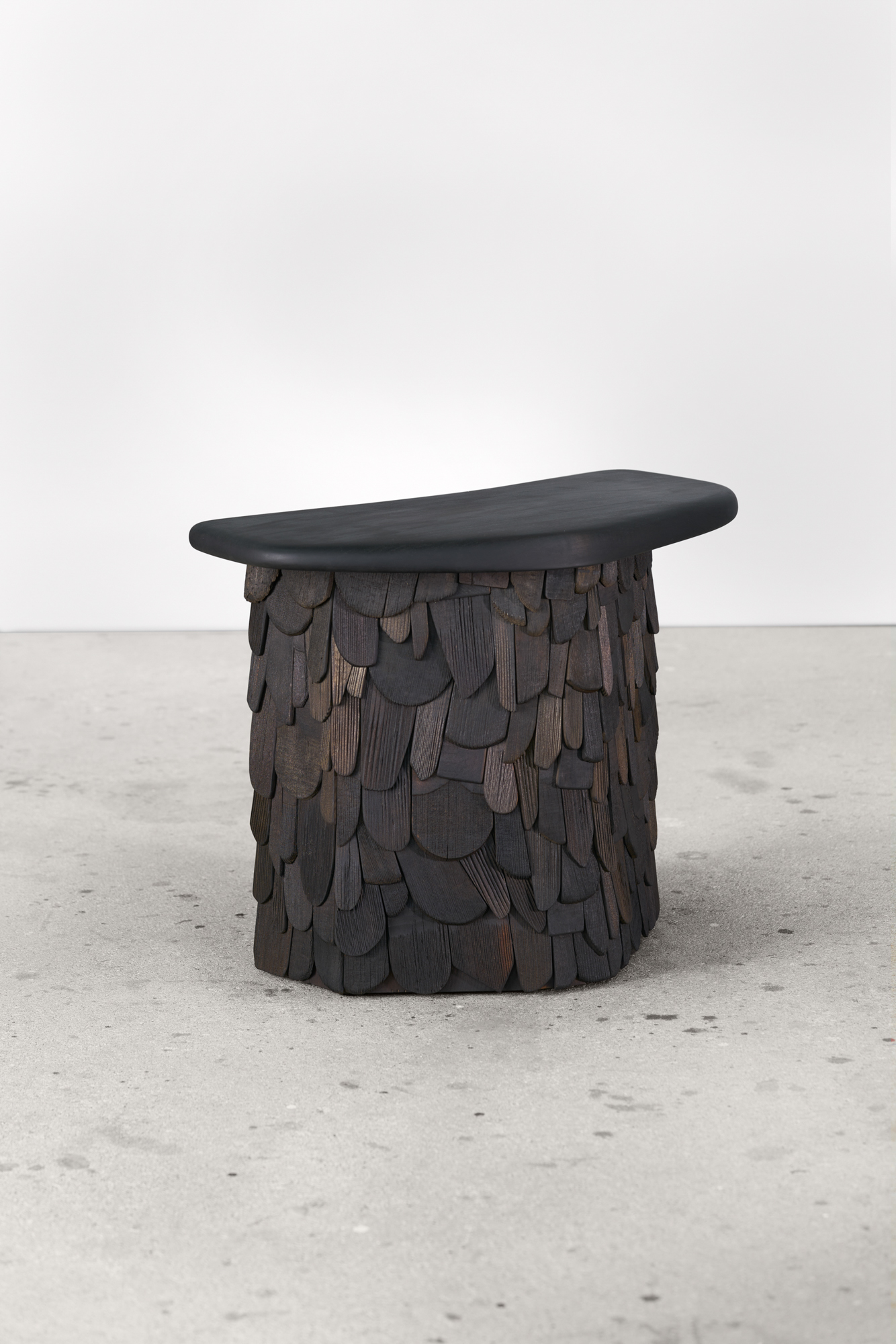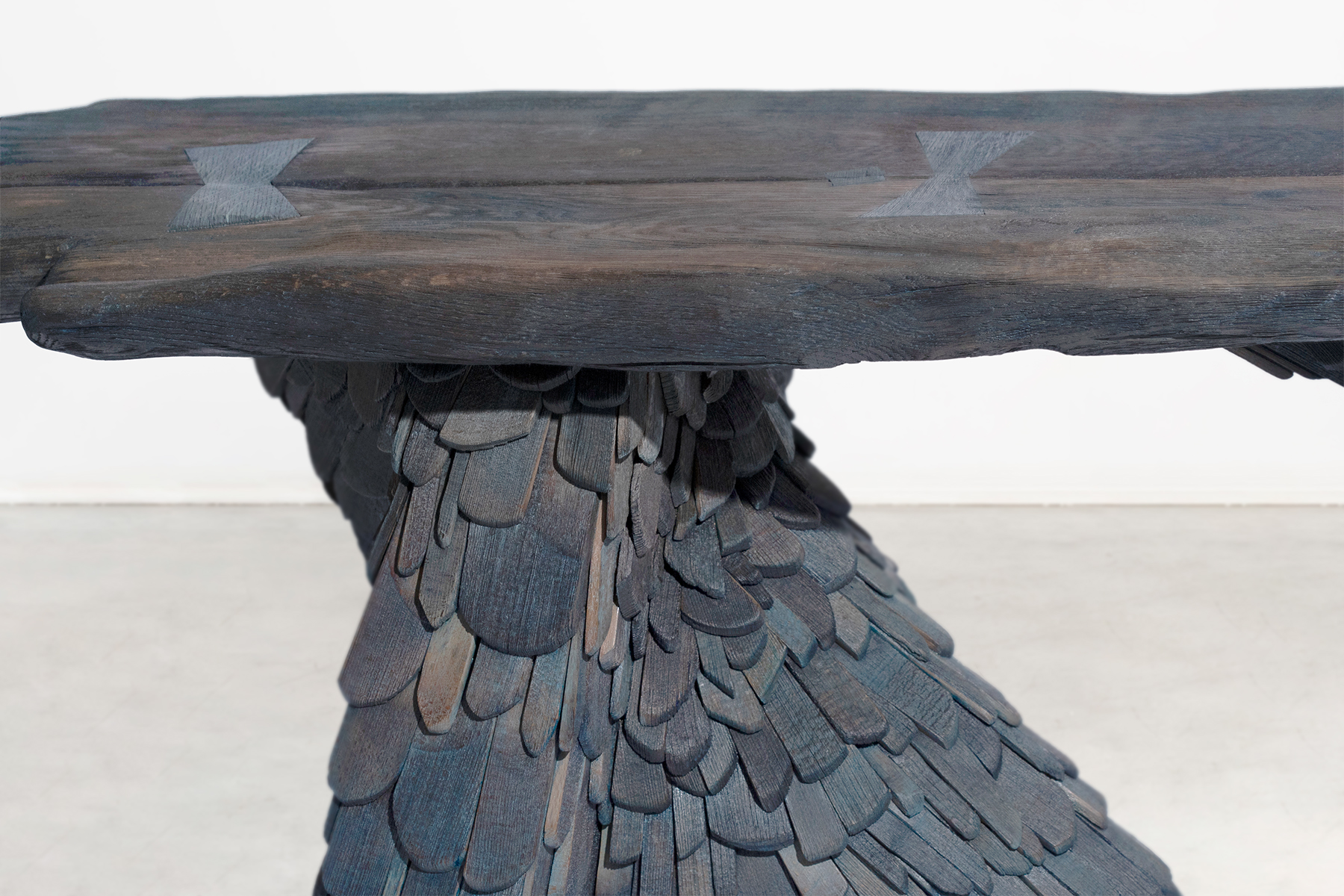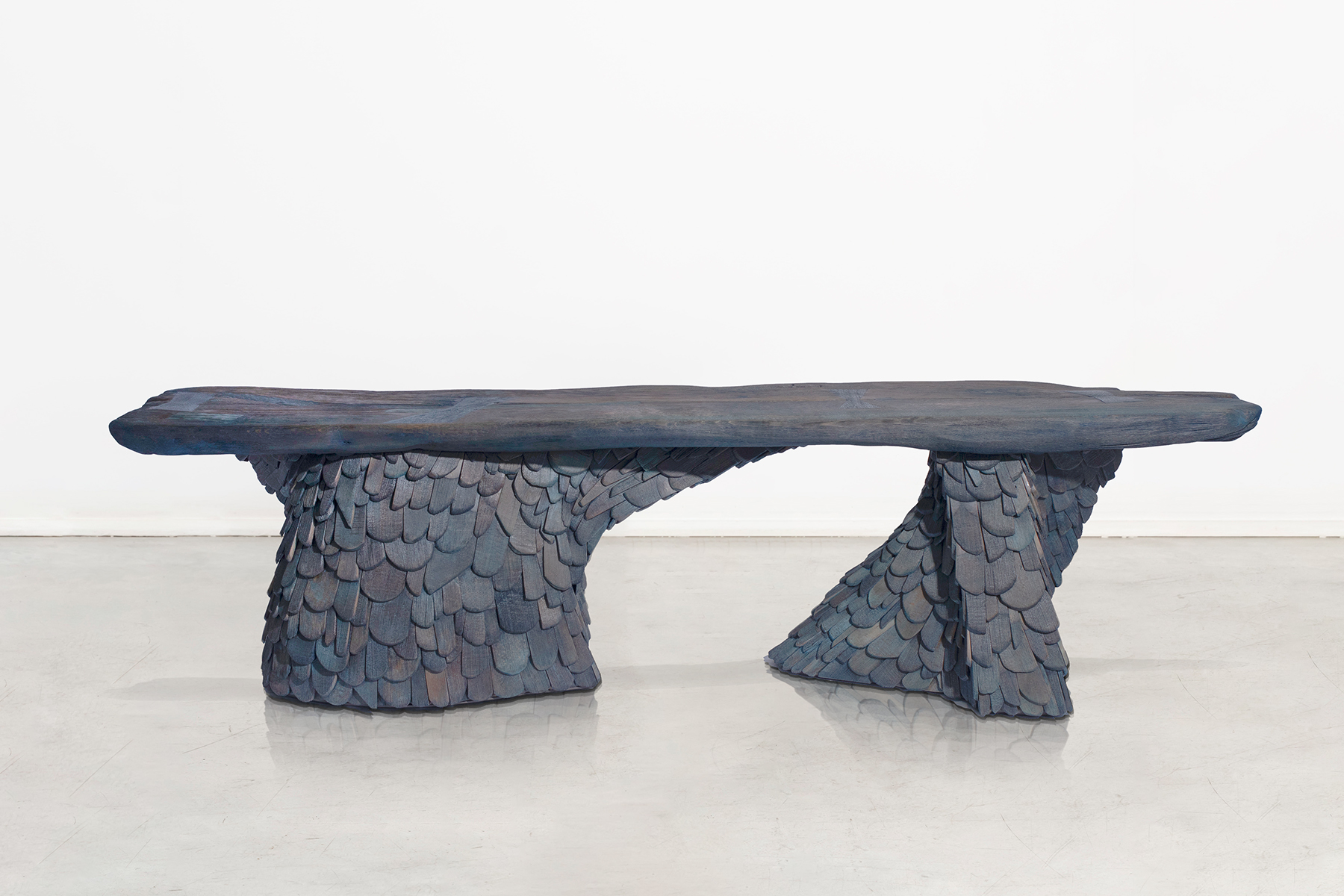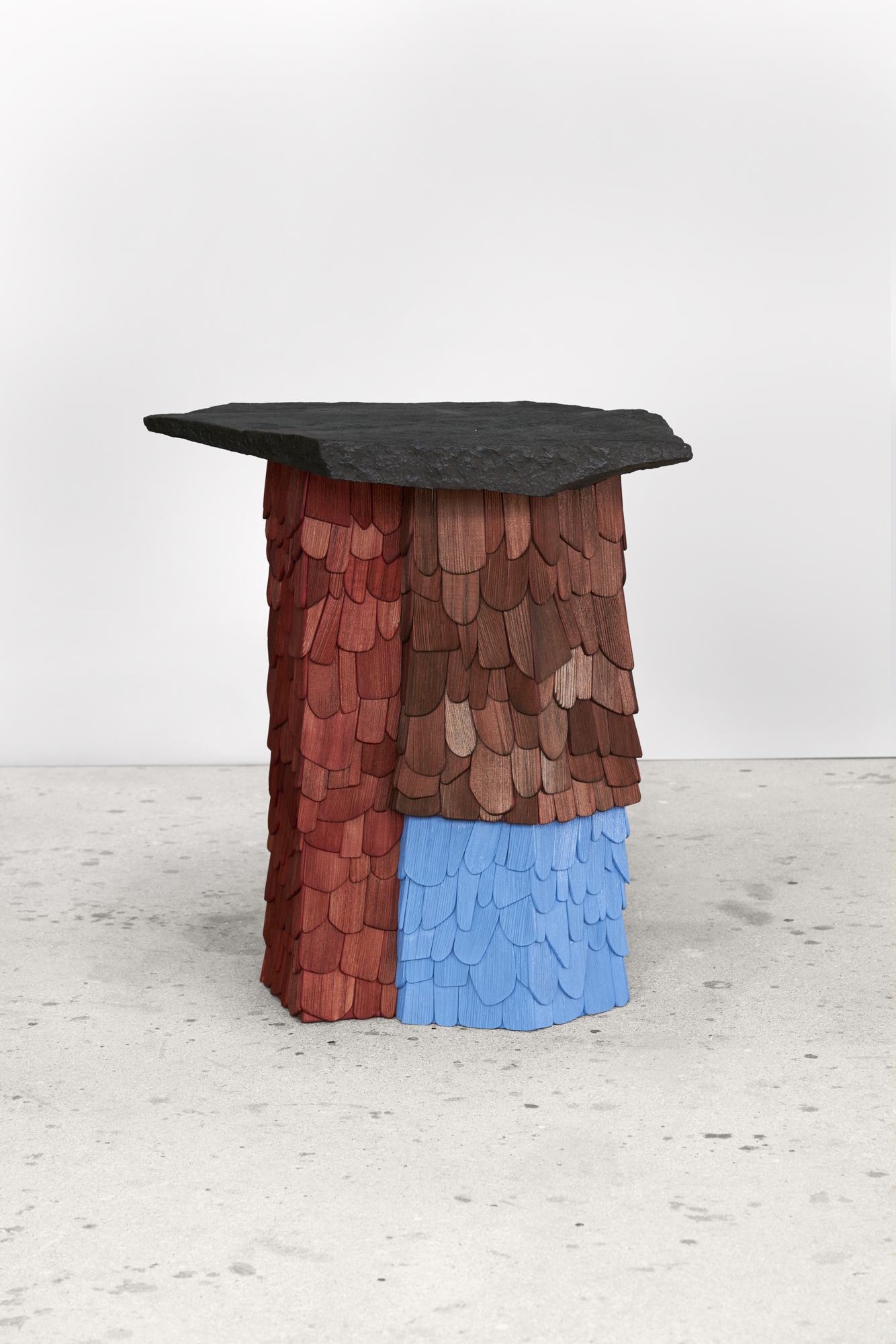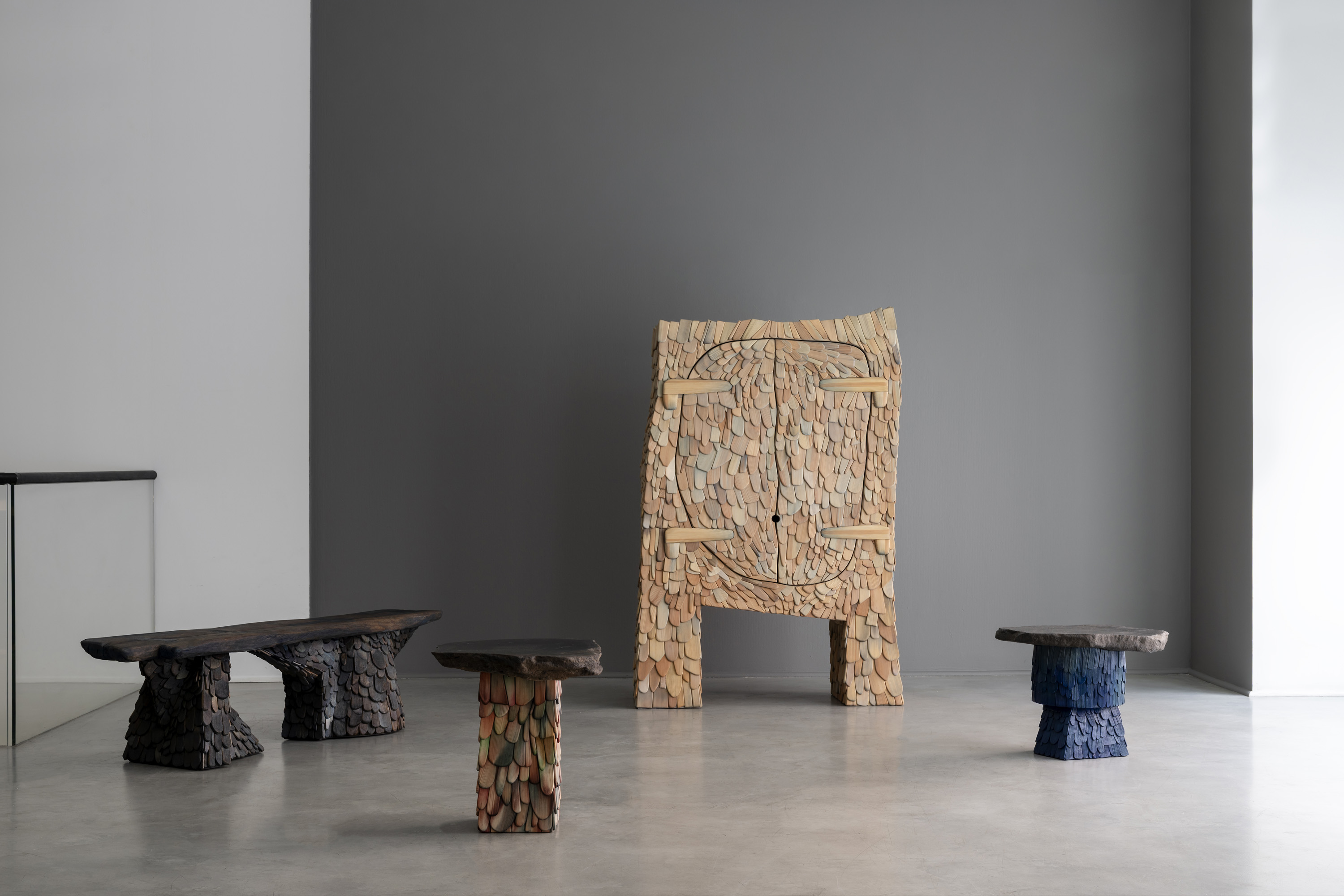
Look closely at the wings of a butterfly, the scales of a fish or the shell of the armadillo and you will encounter the same idea, one that has held the focus of makers Lukas Wegwerth and Corinna Dehn for Companions, an exhibition developed in close collaboration with Gallery FUMI. Bringing together new works that mark a significant and considered evolution in their ongoing Armadillo series, this exhibition features cabinets, a chair, a dining table, a console, side tables, and a birdhouse, all united by a a universal design logic: the shingle.
In architecture–most notably in the Vogelsberg region of central Germany, where Wegwerth and Dehn maintain a second studio–the shingle has functioned for centuries as both protective cladding and building unit. The pair’s intimacy with this form came through the practical task of renovating their home and studio in the Vogelsberg. A signature of the region, popular for its practicality over any fondness of its beauty, the shingle had never been a commercial item. Through salvaging much of the cladding from their renovation, Wegwerth and Dehn came to contemplate the material strategy of the shingle and the place it might have in more finished, indoor objects.
For Wegwerth and Dehn, the shingle is more than a material or a reference. It is a universal concept, a structural logic that recurs both in nature and man-made designs. Fish scales, butterfly wings, the plated shell of the armadillo exemplify how living things have independently turned to that shape to create structures that combine protection, flexibility, and form. The armadillo, with its firm carapace, gave the series its name. The butterfly is a newer point of reference. Viewed under a microscope, the patterns and colours of their wings show the same design language as the armadillo’s shell. That a single shape can answer to both protection and lightness is central to the this body of work.
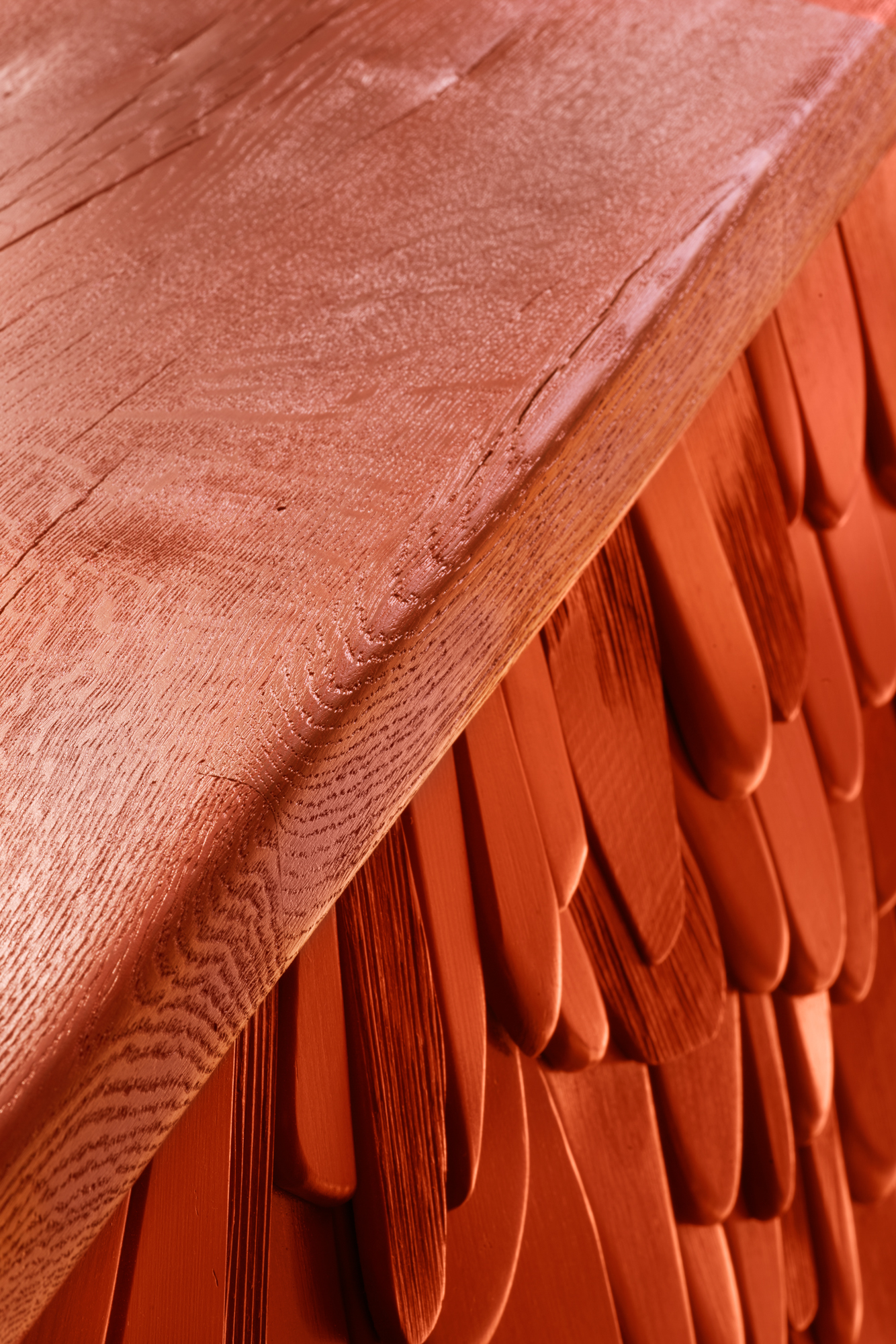
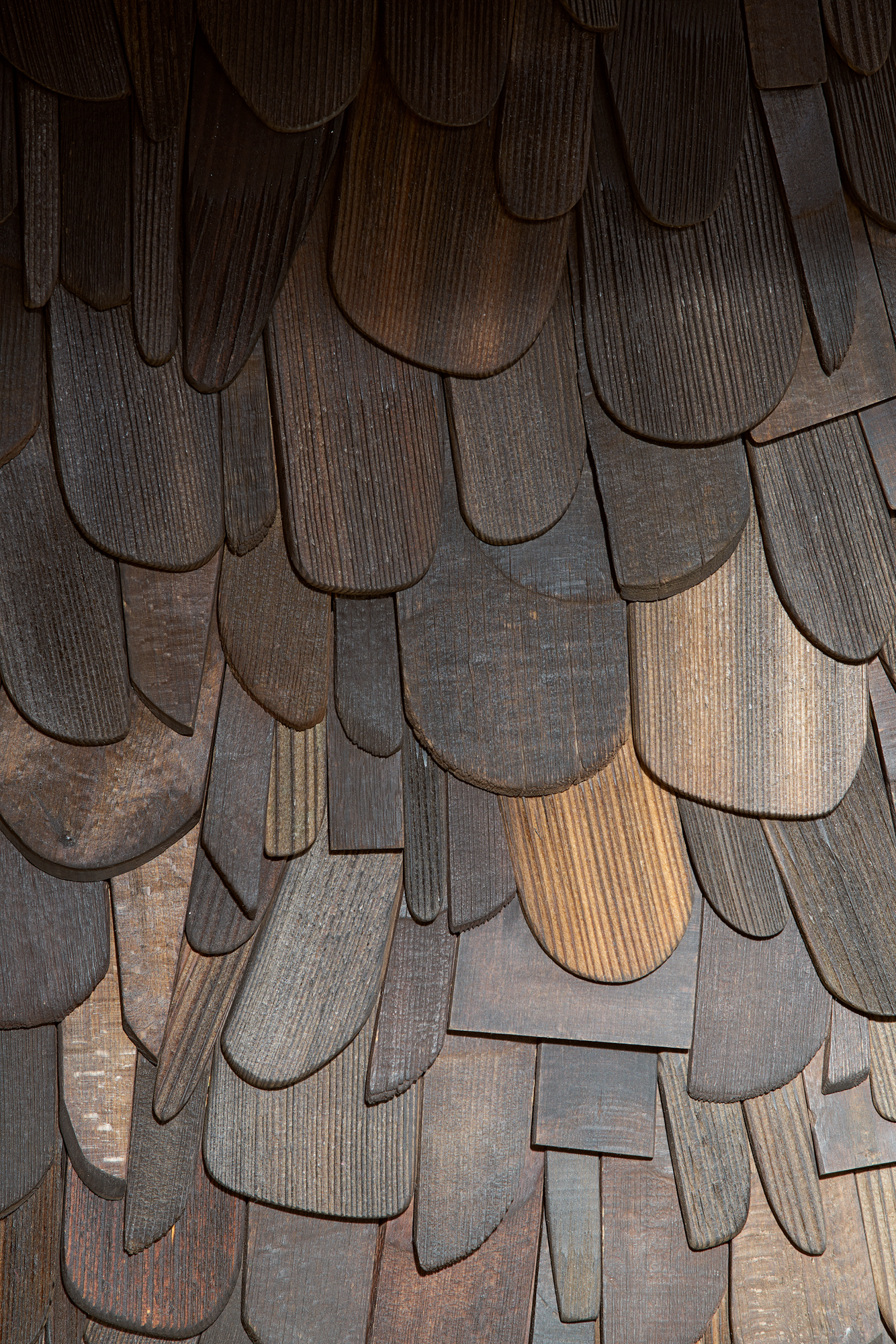
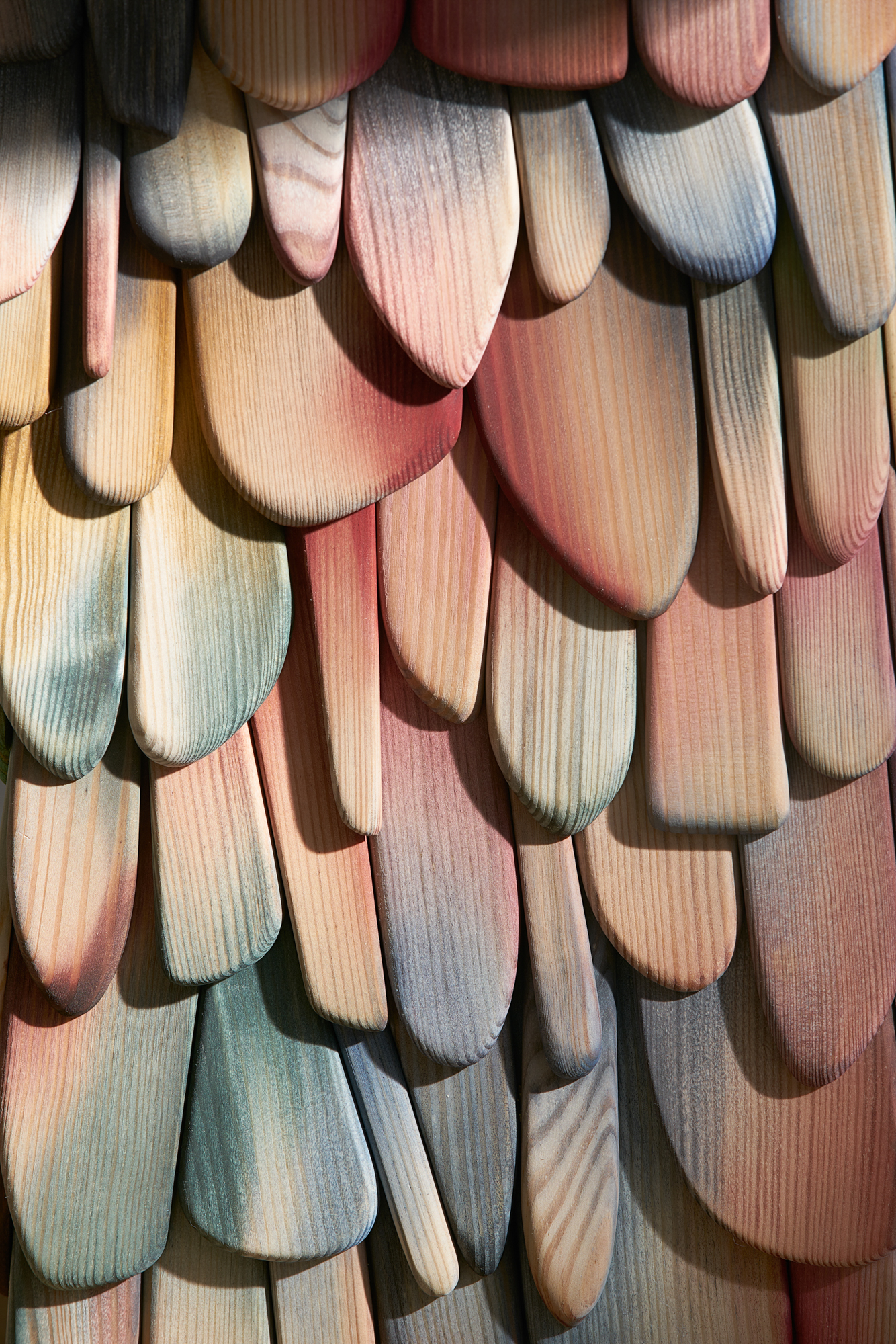
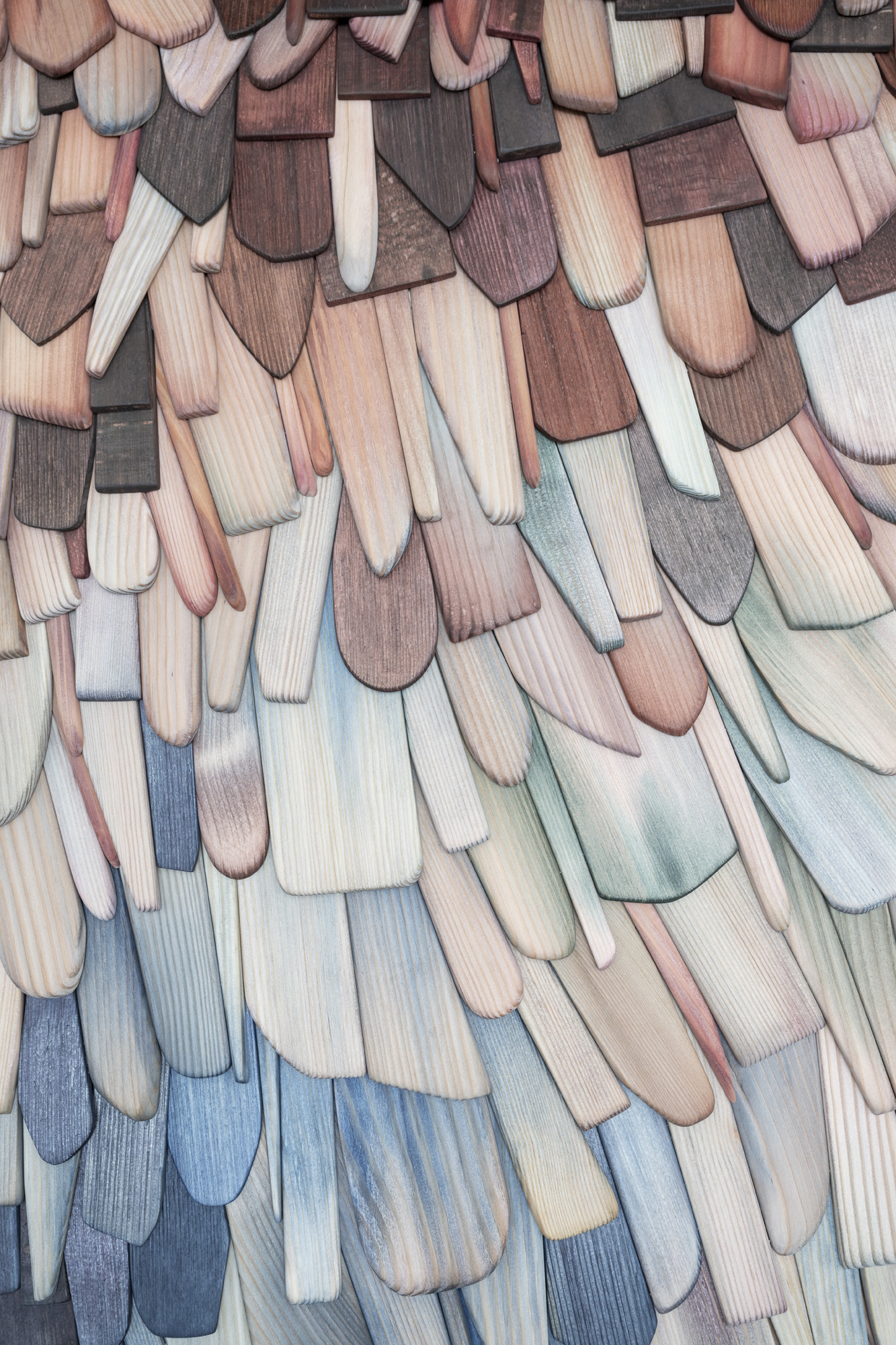
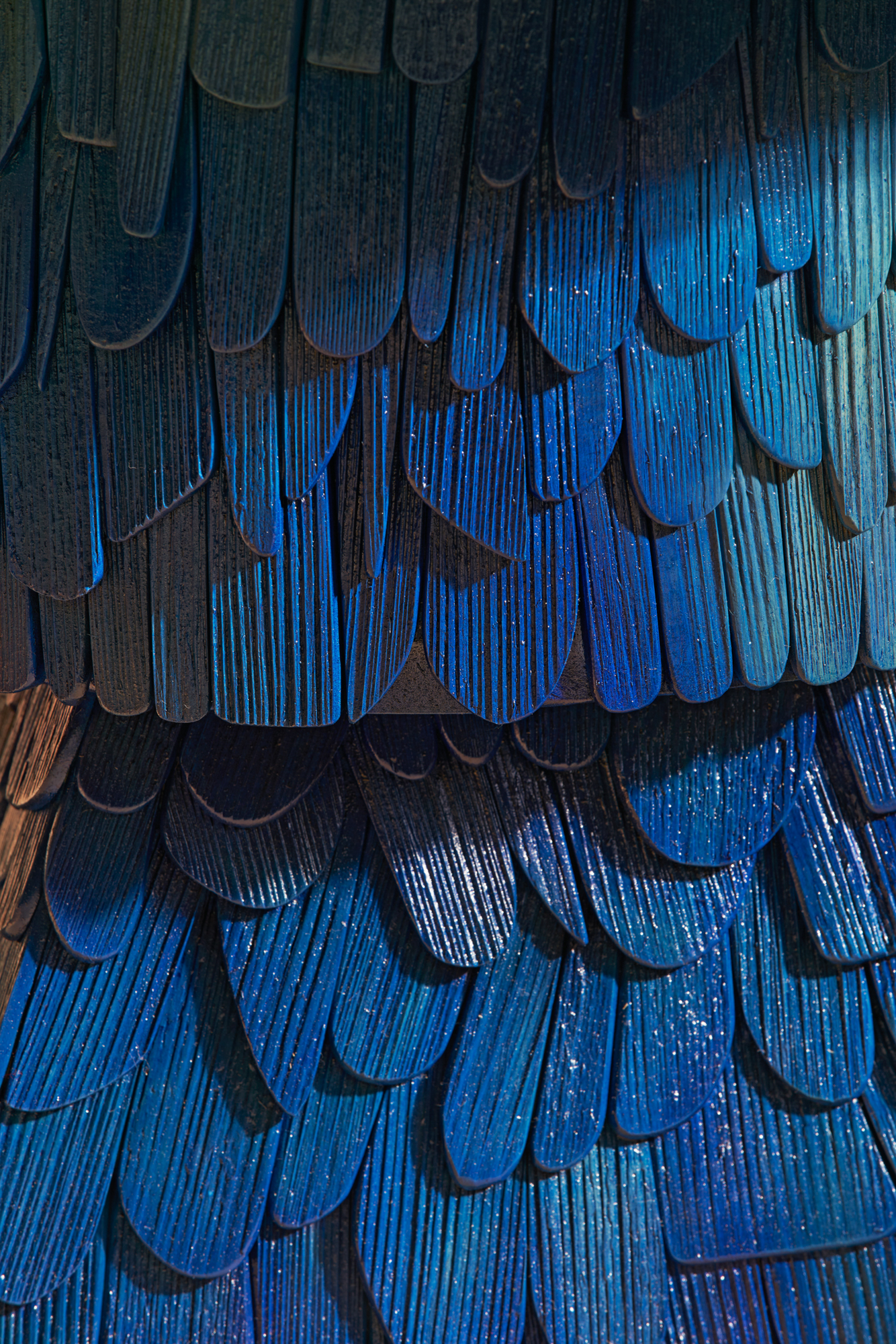
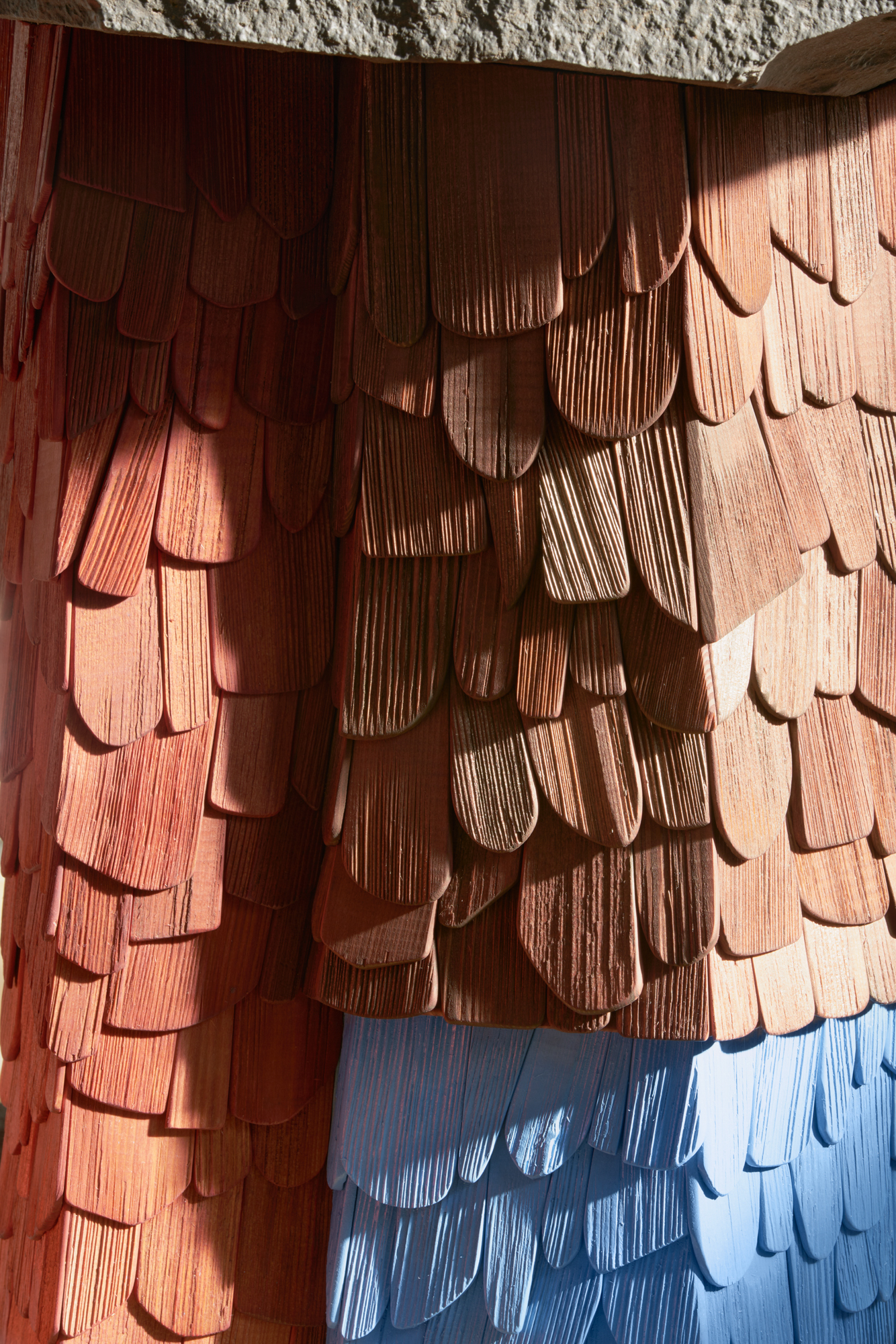
For this exhibition, the logic of the shingle is extended in new directions. The works that debut here push the series toward greater chromatic contrast and pattern. New experimentations in the tone, density, and temperature of colour define these companions. The use of natural pigments deepens the atmospheric range of the work, such as traditional oil paints from the Vogelsberg region, and an ebonising process in which tannins in the wood react with iron to produce shades of brown and black. Every shingle, stained or painted by hand, is treated with a unique application of colour. Variations in both the density and blend of the stain means no two shingles are ever alike.
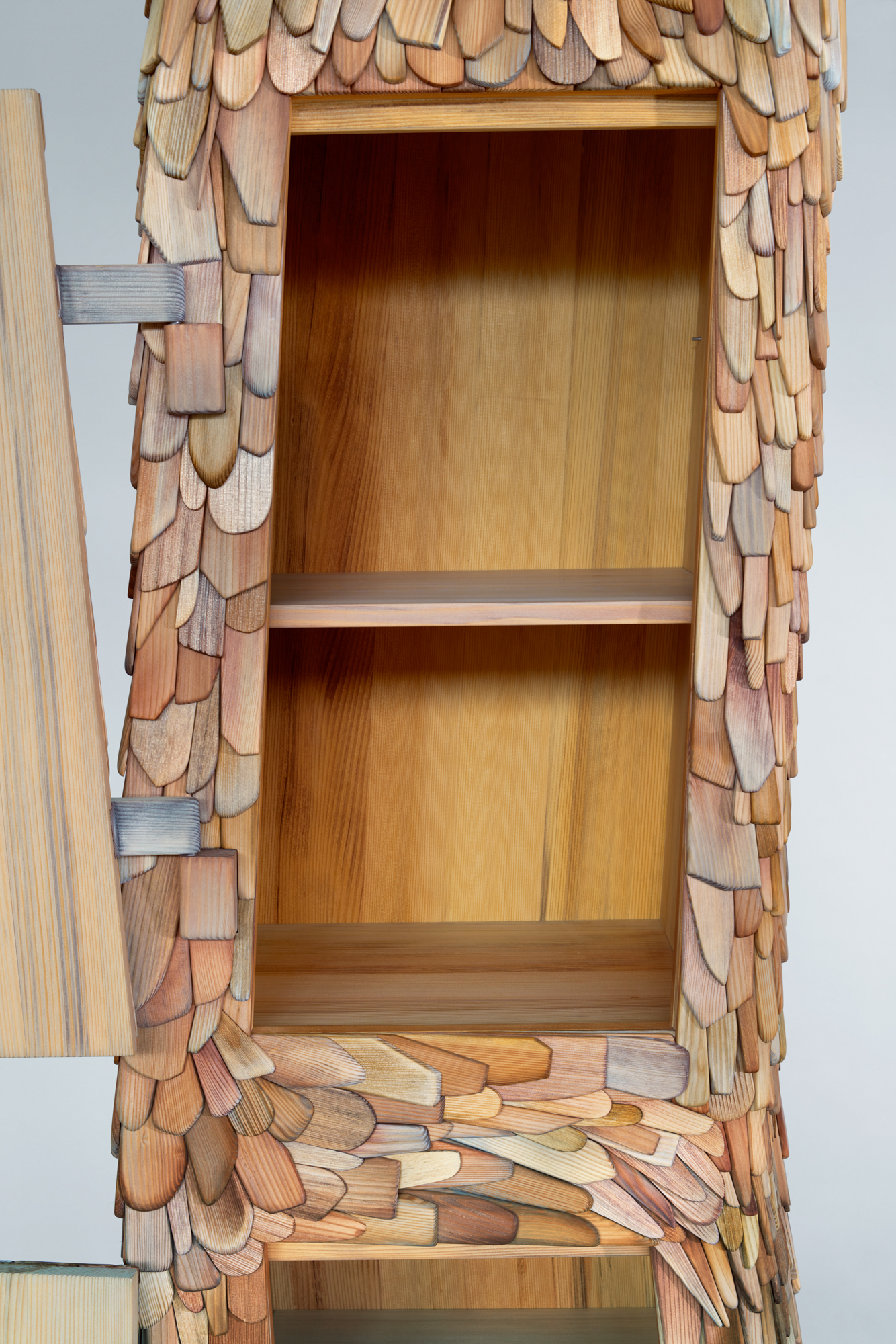
The wood itself also carries history. The shingles are sourced from the forests and old buildings surrounding the studio: beams from barns, timbers from houses that are several hundred years old as well as materials from past functional objects are woven into these works. Some shingles may be a century old, and many of the beams had already served in an earlier building before reaching the studio. For both makers, this provenance is an important part of the work’s narrative. To work with a material whose origin is known is, as Wegwerth and Dehn describe it, an important and liberating thing. When viewed up close, subtle weathering can be seen on a number of these salvaged shingles, making them a record of climate, place, and time. At a time when the beech forests of the Vogelsberg are under strain from climate change and overconsumption, sourcing the materials for this exhibition through pre-existing shingles is in itself a significant effort in preservation.
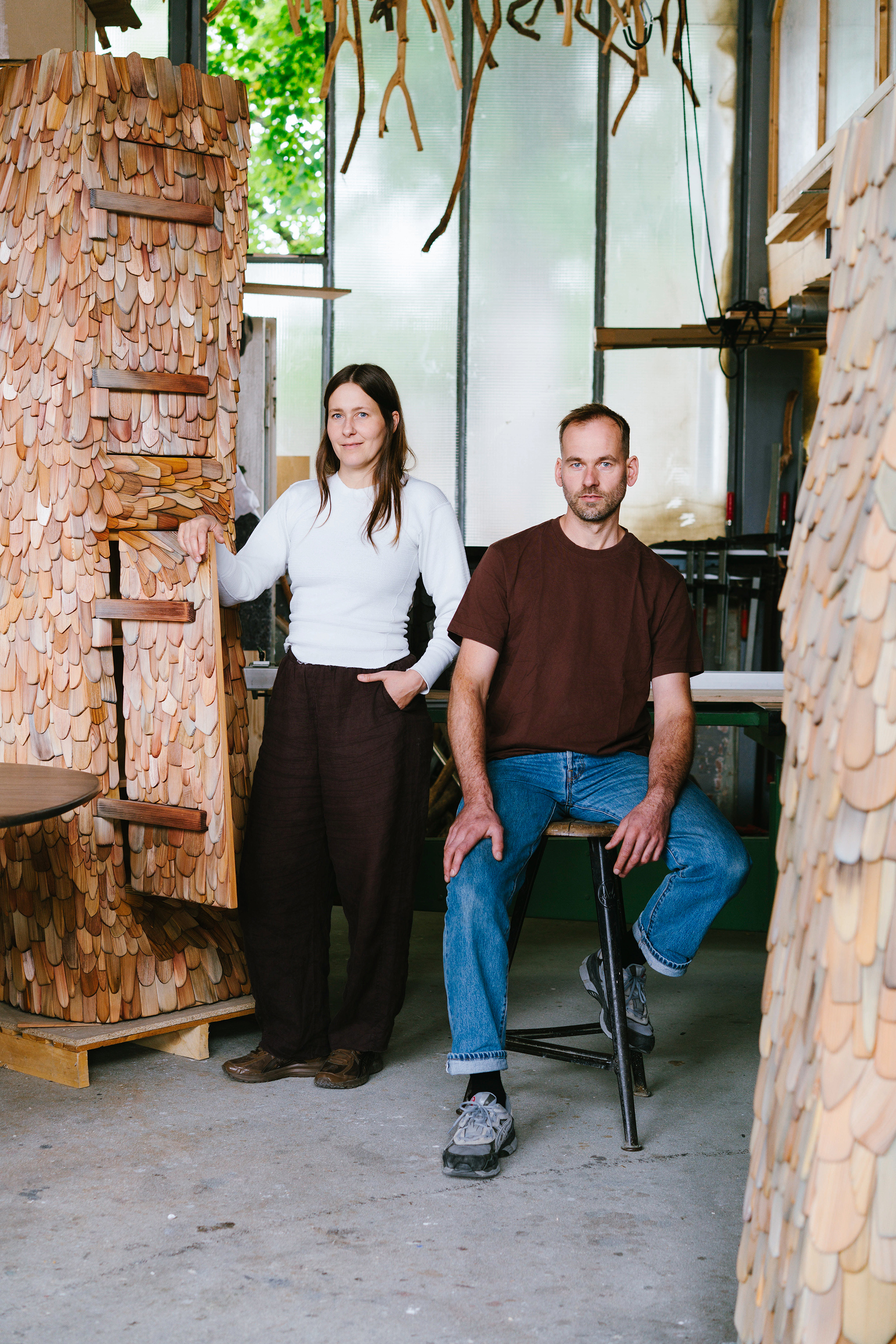
Companions is also a portrait of a collaboration. The overall form and dimensions of each piece are planned together through long conversations and prototyping. From there, the individual shingles are shaped, sanded, and pigmented by Dehn while Wegwerth builds the substructure, developing the interior woodwork with the work’s functional intention as a foremost concern. Together, they apply the shingles and through this stage push each other in directions neither would arrive at alone.
Inherent to the Armadillo project is its slowness. Wegwerth and Dehn methodically work on new material combinations for each object, meaning every piece is the first of its kind. They are, consistently, surprised by what the finished work becomes. Each piece is built from the ground up, shingle by shingle, encasing the formal shape of the interior woodwork. The overall form emerges through a process that is as much discovery as it is design. Where the angles are sharpest, the shingles grow smaller, denser and more intricate, the same logic found on the scaling of fish. The resulting surfaces are both protective and alive, the objects become characters and companions.